In this article
- Andorra's two border crossings: characteristics and differences
- Border with Spain — La Farga de Moles (Riu Runer)
- Border with France — Pas de la Casa (Port d'Envalira)
- How long does it take to cross the Andorra border?
- What are the peak hours at the Andorra border in summer?
- How to avoid queues at the Andorra border?
- Choose the right time to cross
- Check traffic before leaving
- The French border as a real alternative
- The new second lane protocol at Riu Runer (August 2026)
- What documentation do I need to cross the Andorra border?
- EU Citizens
- Non-EU Citizens
- Vehicle Documentation
- What can you bring from Andorra without declaring? Current customs limits
- Products with quantity limits (value does not count)
- Other agricultural products
- Industrial products
- How customs works in practice
- The five most common mistakes at the Andorra border
- How to check the real-time traffic status at the Andorra border
- Do you already know when you're going to cross?
- Are you still defining the plan?
- Frequently Asked Questions
Crossing the Andorra border in summer can take between 5 minutes and over an hour, depending on the day and time slot. The difference doesn't depend on luck: it depends on knowing when to cross, what to bring, and where to check traffic conditions before leaving. This article covers real peak times, waiting times by season, current customs limits, and specific strategies to avoid the most common summer traffic jams.
Andorra's two border crossings: characteristics and differences
Andorra has only two road accesses. There is no airport or train station, which makes these two routes the only entry and exit channels for all traffic in the Principality.
Border with Spain — La Farga de Moles (Riu Runer)
The Spanish-Andorran border is located in La Farga de Moles, in the Alt Urgell region (Lleida). It is accessed via the CG-1 from Andorra la Vella and via the N-145 from La Seu d'Urgell. It concentrates more than 80% of the Principality's total traffic and is the reference point for those arriving from Barcelona, Madrid, Zaragoza, or Valencia. Traveler customs are open 24 hours a day, every day of the year.
Border with France — Pas de la Casa (Port d'Envalira)
The French-Andorran border is located in Pas de la Casa, in the Ariège department. It is accessed via the CG-2 from Andorra la Vella, crossing the Port d'Envalira (2,408 m altitude). Once in France, the RN-22 descends towards L'Hospitalet-près-l'Andorre and connects with the N-20 towards Toulouse. The French customs are open 24 hours. Andorran customs operate Monday to Friday from 7:00 to 20:00 and Saturdays from 8:00 to 12:00 (according to exteriores.gob.es; confirm current hours at govern.ad before your trip).
For those traveling from Spain in summer, the N-145 road becomes the main bottleneck. On days of high traffic, the queue can form several kilometers before reaching La Seu d'Urgell.
Characteristic | Spain (La Farga de Moles) | France (Pas de la Casa) |
Main road | CG-1 / N-145 | CG-2 / RN-22 |
Traveler customs | 24 h, every day | 24 h (French) |
Pass altitude | ~840 m | 2,408 m (Port d'Envalira) |
Traffic peaks | Friday afternoon (entry), Sunday afternoon (exit) | Saturdays during ski season |
Summer traffic | 80%+ of total | Less congestion |
Alternative to the pass | — | Envalira Tunnel (toll) |
How long does it take to cross the Andorra border?
Under normal conditions, between 5 and 10 minutes. During peak hours or holidays, the time can exceed 30-60 minutes at the Spanish border, and on the worst summer days, considerably more.
Data from the Department of Mobility of the Government of Andorra allows for establishing approximate times depending on the season:
Period | Spain Border (La Farga de Moles) | France Border (Pas de la Casa) |
Weekdays, off-peak | 5-10 min | 5-10 min |
Summer weekends (Jul-Aug) | 20-45 min | 15-30 min |
Spanish/French long weekends and holidays | 30-60 min | 30-60 min |
Easter Week | up to 60 min | up to 45 min |
Low season (Oct-Nov, Mar-May) | 5-10 min | 5-10 min |
These ranges are indicative. On the busiest days of summer 2026, queues far exceeded these values. On August 12, 2026, the Department of Mobility reported traffic jams of up to 4 kilometers on the N-145 to enter Andorra, with queues lasting from 11:30 to 15:00; in the afternoon, exit traffic jams exceeded 2 kilometers. On August 17, queues reached 6 kilometers from Pla de Sant Tirs to La Farga de Moles, with an estimated time of 50 minutes just for the La Seu d'Urgell-border section, when under normal conditions it is completed in about 20 minutes.
What are the peak hours at the Andorra border in summer?
Traffic patterns at the Andorra border are predictable. Congestion follows a clear logic: entry concentrates when people arrive for the weekend; exit, when everyone returns at once.
Day | Entry direction | Exit direction |
Monday – Thursday | Smooth all day | Smooth all day |
Friday | Congestion 17:00-21:00 h | Smooth |
Saturday | Congestion 10:00-13:00 h | Smooth in the morning |
Sunday | Smooth | Congestion 15:00-20:00 h |
ES/FR Holidays | High congestion | High congestion |
In summer, an additional factor must be added: the second half of August is the most problematic of the year. August 15th is a national holiday in both Spain and France, leading to an extraordinarily high combination of entry and exit flows. On these days, traffic jams can start forming from early morning and last throughout the afternoon.
How to avoid queues at the Andorra border?
Choose the right time to cross
The most effective strategy is the simplest: avoid peak times and cross during low-traffic periods.

To enter Andorra:
- Tuesdays, Wednesdays, and Thursdays are the days with the least traffic. Crossing is practically immediate.
- If you arrive on a weekend, do so before 9:00 h or after 14:00 h on Saturday.
- On Fridays, avoid the 17:00-21:00 h slot; in the morning, traffic is smooth.
To exit Andorra:
- Sunday is the critical day. If you can leave before 15:00 h or after 20:00 h, you avoid the worst part.
- The early hours of Monday are unusually quiet.
Check traffic before leaving
The Department of Mobility of the Government of Andorra offers real-time information at mobilitat.ad. The platform updates road conditions every few minutes with official data, including alerts for traffic jams, roadworks, and closures. You can also view live traffic cameras at mobilitat.ad/totes-les-cameres: there are cameras at Pont de la Margineda, Pas de la Casa, and Port d'Envalira, among other locations.
Other useful real-time sources:
- Google Maps and Waze — reflect traffic jams quite accurately
- @transitn145 on Twitter/X — traffic alerts on the N-145 between La Seu d'Urgell and the border
- @transitc14 on Twitter/X — alerts on the C-14, which feeds access from Lleida and the south
- Servei Català de Trànsit: 93 567 40 00
The French border as a real alternative
When the Spanish border is congested (especially on summer Sundays and August 15th), Pas de la Casa is an alternative that can save you between 30 and 60 minutes. From Andorra la Vella, it's about 30 km via the CG-2 to the border, taking just under 45 minutes without traffic.
From Pas de la Casa, the RN-22 connects directly to the French N-20 towards Toulouse (approximately 2 h 30 min to the city). If your final destination is in the south of France or even Barcelona by taking the French highway, this option might be worth the detour.
Keep in mind that Port d'Envalira can generate its own traffic on certain days. The Túnel d'Envalira (5.7 km), which crosses the mountain and bypasses the pass, is the toll alternative. Check the updated fare on the tunnel's official website before leaving.
The new second lane protocol at Riu Runer (August 2026)
On August 14, 2026, the Government of Andorra and the Spanish National Police announced a new coordination protocol to expedite the opening of the second entry lane at the Riu Runer border. The agreement, confirmed by the Secretary of State for Energy Transition, Transport, and Mobility, David Forné, establishes a more agile coordination mechanism between both administrations so that the second lane can be enabled more quickly during peak traffic intensity.
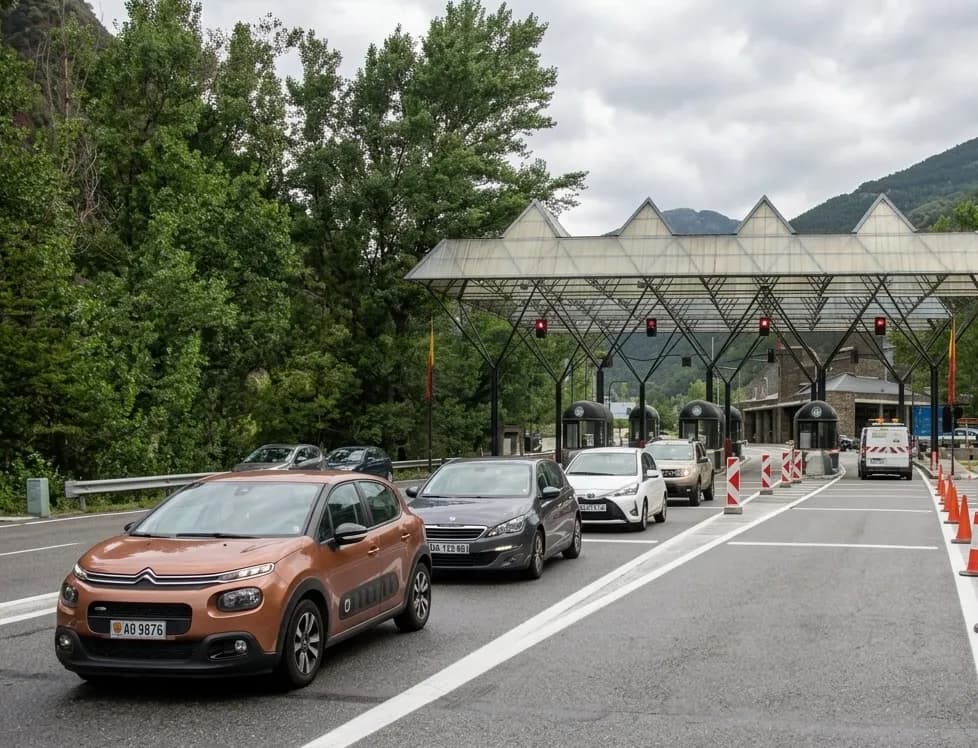
The measure directly responds to the traffic jams recorded that same week, where queues exceeded 6 kilometers on the N-145. On the afternoon of August 14, the second lane was activated and helped normalize traffic flow.
This protocol does not eliminate queues on days of highest influx, but it reduces reaction time to increase passage capacity when the situation requires it.
What documentation do I need to cross the Andorra border?
Andorra is not part of the European Union nor of the Schengen Area, but it has free transit agreements with Spain and France. In practice, European citizens cross without additional procedures, although they must always carry valid documentation.
EU Citizens
- Valid ID card or passport for all vehicle occupants, including minors.
- Minors accompanied by their parents: ID card or passport and, in Spain, the family book is recommended although not always required.
- Minors traveling with people who are not their parents or guardians: it is recommended to carry a notarized parental authorization. Checks are random, but if stopped, the lack of authorization can complicate the crossing.
Non-EU Citizens
Since to reach Andorra you must first cross Spain or France, citizens from countries requiring a visa for the Schengen Area must apply for a double-entry or multiple-entry Schengen visa, as upon leaving Andorra they re-enter Schengen territory. A single-entry visa is not sufficient.
Citizens from countries without Schengen visa requirements only need a valid passport.
Vehicle Documentation
Regardless of nationality, the driver must carry:
- Valid driving license
- Vehicle documentation (valid ITV/MOT, insurance)
- If the vehicle is rented: rental agreement.
What can you bring from Andorra without declaring? Current customs limits
Customs allowances are the limits of products a traveler can take from Andorra to Spain or France without paying additional duties or taxes. They apply per person and only for personal use (non-commercial). The following values correspond to the information published on govern.ad/franquícies.
Products with quantity limits (value does not count)
Product | Limit per person (over 17 years old) |
Cigarettes | 300 units |
Cigars (< 3 g/unit) | 150 units |
Cigars (> 3 g/unit) | 75 units |
Pipe tobacco | 400 g |
Spirits > 22° vol. | 1.5 L |
Spirits < 22° / Cava / Sparkling wines | 3 L |
Still wine | 5 L |
Coffee | 1,000 g (or 400 g of extract) |
Tea | 200 g (or 80 g of extract) |
Perfume | 75 g |
Eau de cologne / toilet water | 375 ml |
Minors under 17 years old have no allowance for tobacco or alcohol.
Other agricultural products
Up to an accumulated value of 300 € per person, without exceeding these quantities: 2.5 kg of powdered milk, 3 kg of condensed milk, 6 L of liquid milk, 1 kg of butter, 4 kg of cheese, 5 kg of sugar and sweets, 5 kg of meat.
Industrial products
Up to 900 € in value per person (electronics, clothing, accessories, and similar). For minors under 15, EU member states may apply a reduced allowance.
How customs works in practice
Entry into Andorra from Spain or France usually does not involve checks: Andorran authorities prioritize facilitating the arrival of visitors. It is the exit that is actively controlled by the Spanish Civil Guard or the French Customs (Douanes françaises).
Checks can be random (every certain number of vehicles) or targeted (vehicles with low suspension, license plates with frequent crossings, vans, rental cars). In both cases, the officer may ask you to open the trunk and inform you about the products you are carrying. If you declare correctly, the process is quick. If you exceed the limits, the goods may be confiscated and financial penalties may be imposed.
Checks are more likely on Friday and Sunday afternoons, holidays, and long weekends, precisely when vehicle volume is highest.
The five most common mistakes at the Andorra border
1. Leaving Andorra on Sunday between 3:00 PM and 8:00 PM without checking traffic. This is the most congested period of the week throughout the year. If you cannot avoid it, at least check mobilitat.ad before leaving to know how much time to allow.
2. Trying to combine allowances between family members for a single product. Allowances are individual and non-transferable. You cannot combine those of several travelers to take a product of greater value or quantity.
3. Not keeping purchase receipts. If you carry electronics, clothing, or any industrial product above a significant amount and do not have an invoice, in case of inspection you will not be able to prove its value or origin. Always keep your receipts.
4. Assuming the French border will also be congested. When the Spanish border experiences significant delays, the Pas de la Casa border is usually much clearer. It's a real alternative that very few travelers use.
5. Not having your ID readily available upon arrival at customs. It seems basic, but on busy days, having to rummage through your bag with a line of cars behind you creates unnecessary tension and slows down the crossing. Have it accessible before you arrive.
How to check the real-time traffic status at the Andorra border
The Departament de Mobilitat of the Government of Andorra is the official source for checking the status of Andorran roads:
- mobilitat.ad — general status of the road network, updated every 5 minutes
- mobilitat.ad/totes-les-cameres — live cameras: Pont de la Margineda, Pas de la Casa, Port d'Envalira, CG-1, CG-2 and access roads to Andorra la Vella
- App "Mobilitat Andorra" — available to check from your mobile before leaving
- @transitn145 on X/Twitter — specific alerts for the N-145
- @transitc14 on X/Twitter — alerts for the C-14 (access from Lleida/Poniente)
- Servei Català de Trànsit: 93 567 40 00 — for inquiries about the status of Catalan access roads
Practical recommendation: check the mobilitat.ad cameras about 30-45 minutes before leaving. If queues have already formed, this margin allows you to adjust your departure time or consider the French alternative.
Do you already know when you're going to cross?
If you plan to stay overnight in Andorra, it's the best time to secure your accommodation. Check and choose your entry with flexibility.
Are you still defining the plan?
In our experiences section you will find +150 activities of all kinds to do at any time of the year.
Frequently Asked Questions
You may be interested in
Most read