In this article
- What is the Volta als Ports of Andorra?
- Date, start and finish location 2026
- The 5 routes of the Volta als Ports 2026
- Route Summary Table
- Which route to choose based on your level?
- The innovative format: only climbs are timed
- Registration fees 2026
- Weekend Program: Saturday, July 18 and Sunday, July 19
- Saturday, July 18 — Expo and bib collection
- Sunday, July 19 — Event Day
- The mountain passes: what awaits you on each climb?
- Coma d'Arcalís (present on all routes)
- Coll d'Ordino (routes 2, 3, 4 and 5)
- Puerto de Beixalís (routes 3, 4 and 5)
- Port de Cabús (routes 4 and 5)
- Alto de la Comella (route 5 only)
- Services at the finish line: what's at Parc Central
- How to get there and where to park
- Where to stay: accommodation for the Volta als Ports
- Practical tips for preparing for the Volta als Ports
- Common mistakes to avoid
- Frequently asked questions
If you are looking for information about the Volta als Ports Andorra 2026, you are in the right place. This year's edition takes place on July 19, 2026 starting from La Massana, and it is the oldest and most anticipated cycling event on the Andorran calendar. Here you will find the 5 routes with their distances and elevation gains, updated registration prices, the full weekend program, and everything you need to organize your travel and accommodation.
What is the Volta als Ports of Andorra?
The Volta als Ports d'Andorra —or Jorma Volta als Ports, as it appears in its official name since Jorma Bike took over sponsorship— is the most historic cyclotourist ride in the country. It was born in 1977 and since then has become a classic of Pyrenean cyclotourism, attracting cyclists from all over Spain, France, and Portugal. In 2026, it celebrates its 48th edition.
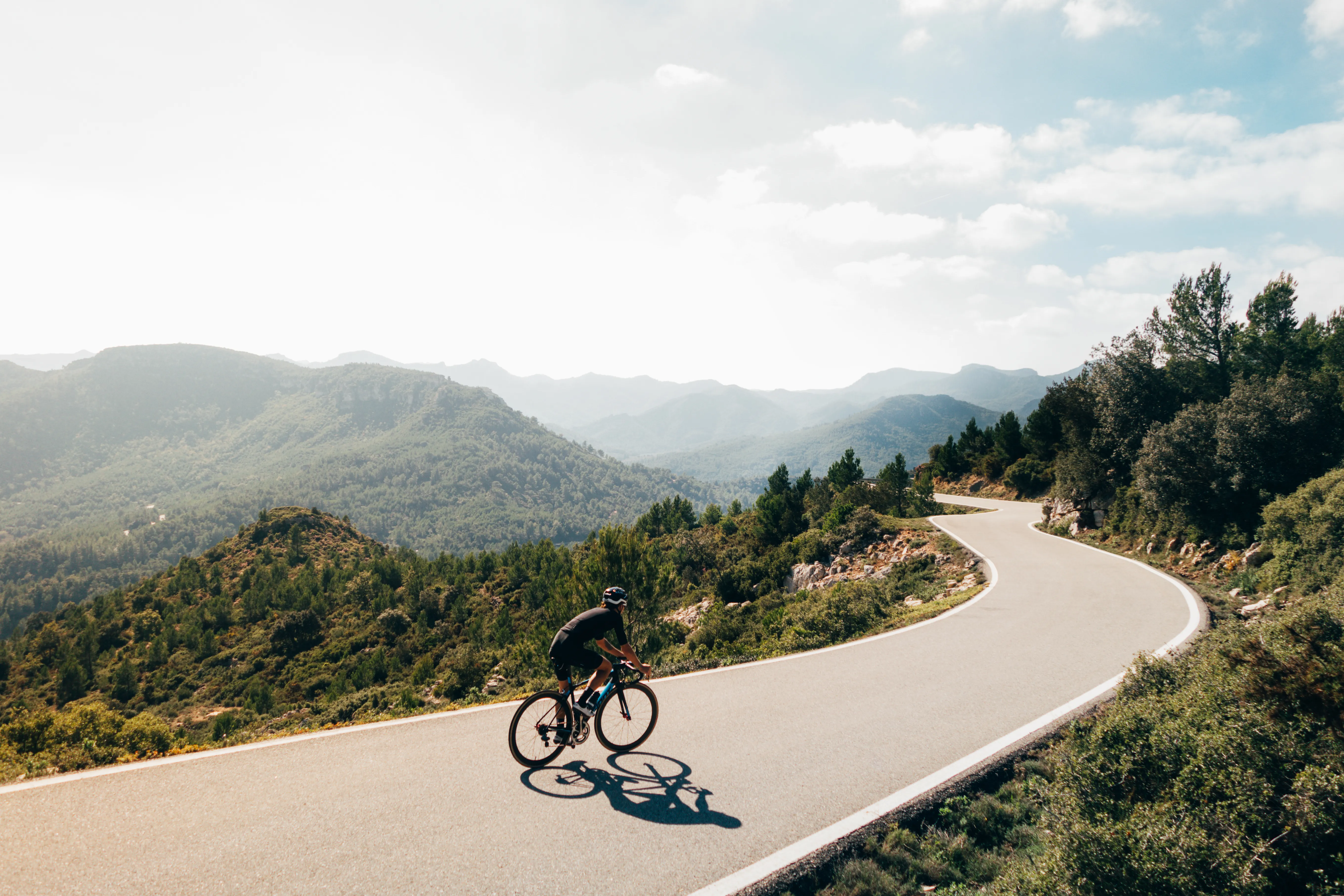
It is not a race in the usual sense. It is a cyclotourist ride that combines the real challenge of climbing Andorra's most emblematic passes with the possibility of enjoying the descent without time pressure, eating calmly at the aid stations, and reaching the finish line with the satisfaction of having achieved something memorable. The current format clearly differentiates it from conventional gran fondos, and this generates a participant loyalty that few cyclotourist events achieve.
If you want to know more outdoor activities to do in Andorra in summer, check out our section on Things to do in Andorra.
Date, start and finish location 2026
The 48th edition of the Jorma Volta als Ports takes place on Sunday, July 19, 2026, starting from La Massana. Specifically, the starting point is Plaça de les Fontetes, in the center of the parish, where participants gather before the mass start.
The finish line for all routes is mandatory at Parc Central de Andorra la Vella, where the finish village is set up with all services for participants and companions.
Key facts at a glance:
Fact | Information |
|---|---|
Edition | 48th (since 1977) |
Date | Sunday, July 19, 2026 |
Start | Plaça de les Fontetes, La Massana |
Finish | Parc Central, Andorra la Vella |
Available routes | 5 (from 1 to 5 stars) |
Organizers | Agrupació Ciclista Andorrana + VSL Sports |
The 5 routes of the Volta als Ports 2026
The event offers five participation options with progressive difficulty, from the most accessible route —with a single climb to Arcalís— to the full challenge with five ascents including Cabús, Beixalís, and La Comella.
These are the five routes:
Route 1* — 52 km / 1,080 m elevation gain, with a timed section from Serrat to Coma d'Arcalís.
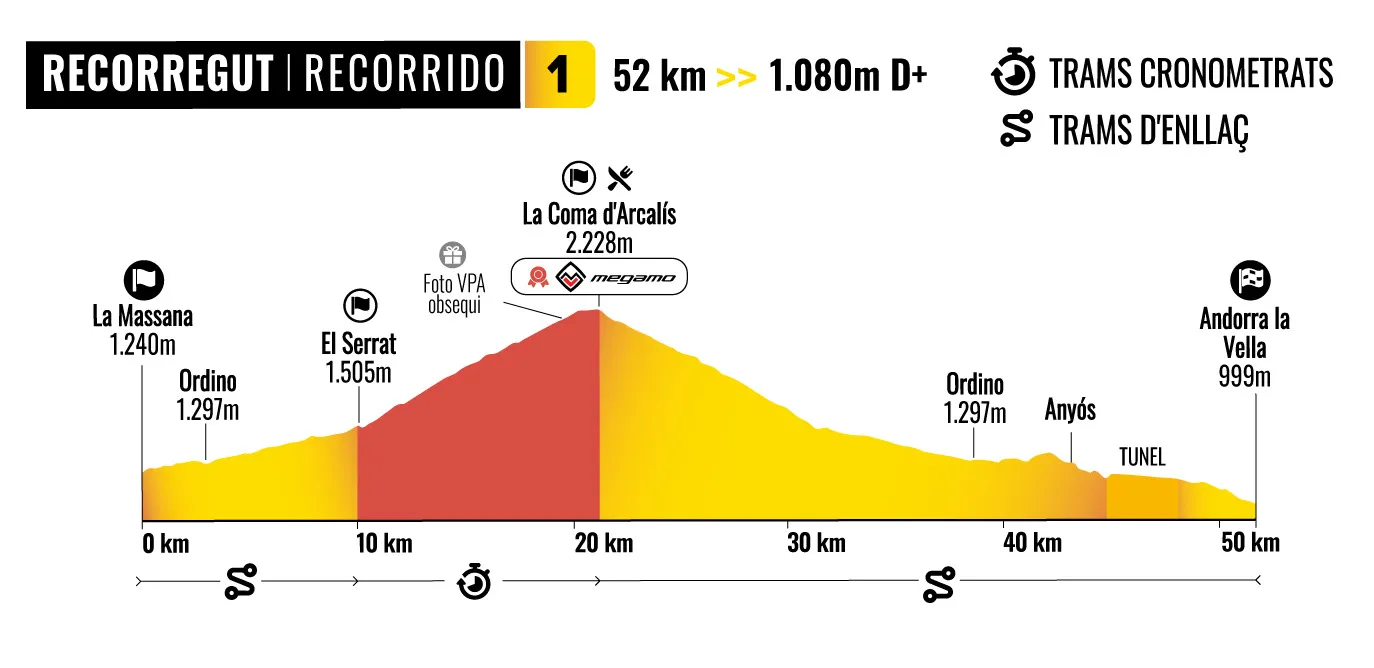
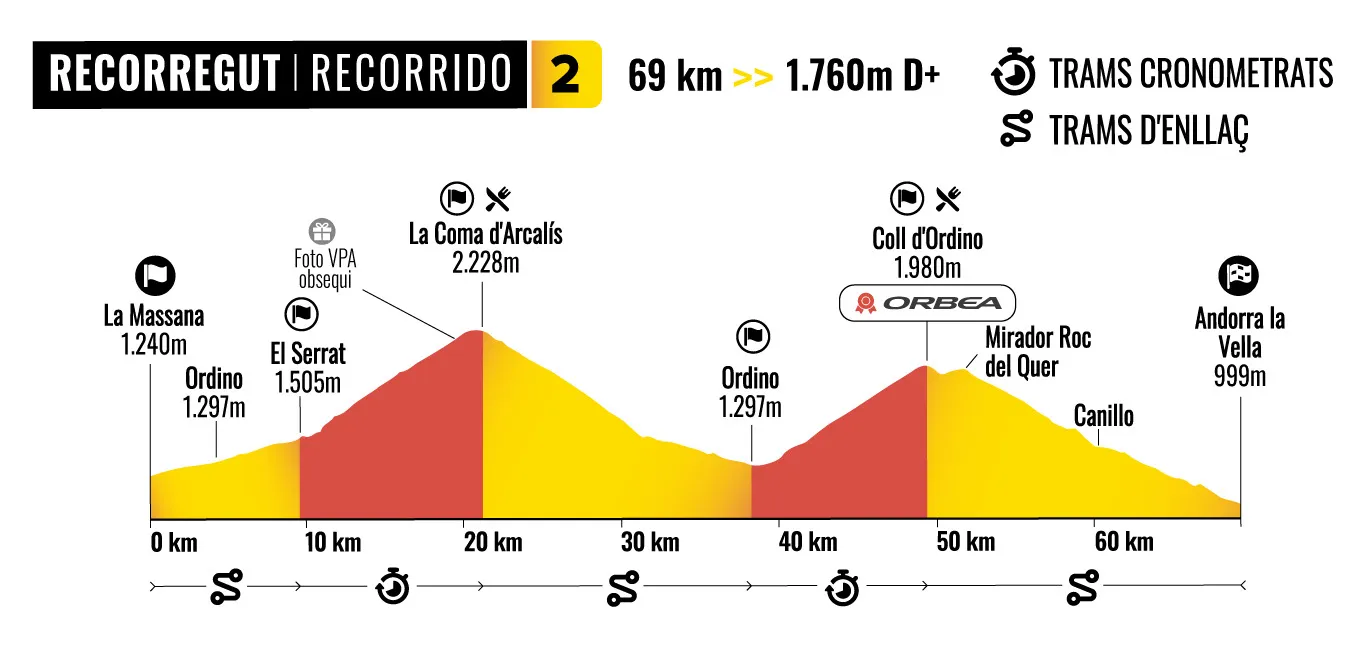
Route 2* — 69 km / 1,760 m elevation gain, with timed sections from Serrat to Coma d'Arcalís and from Ordino to Collada d'Ordino.
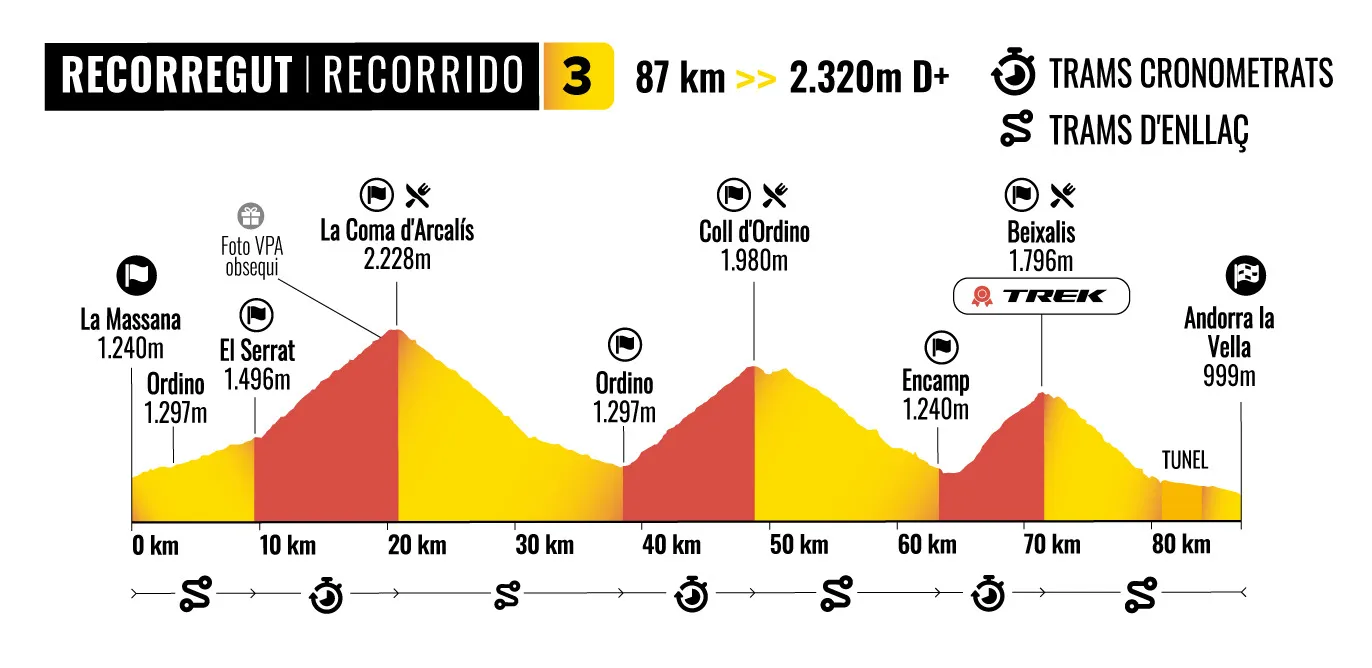
Route 3* — 87 km / 2,320 m elevation gain, with the same timed sections as route 2 plus from Encamp to Beixalís.
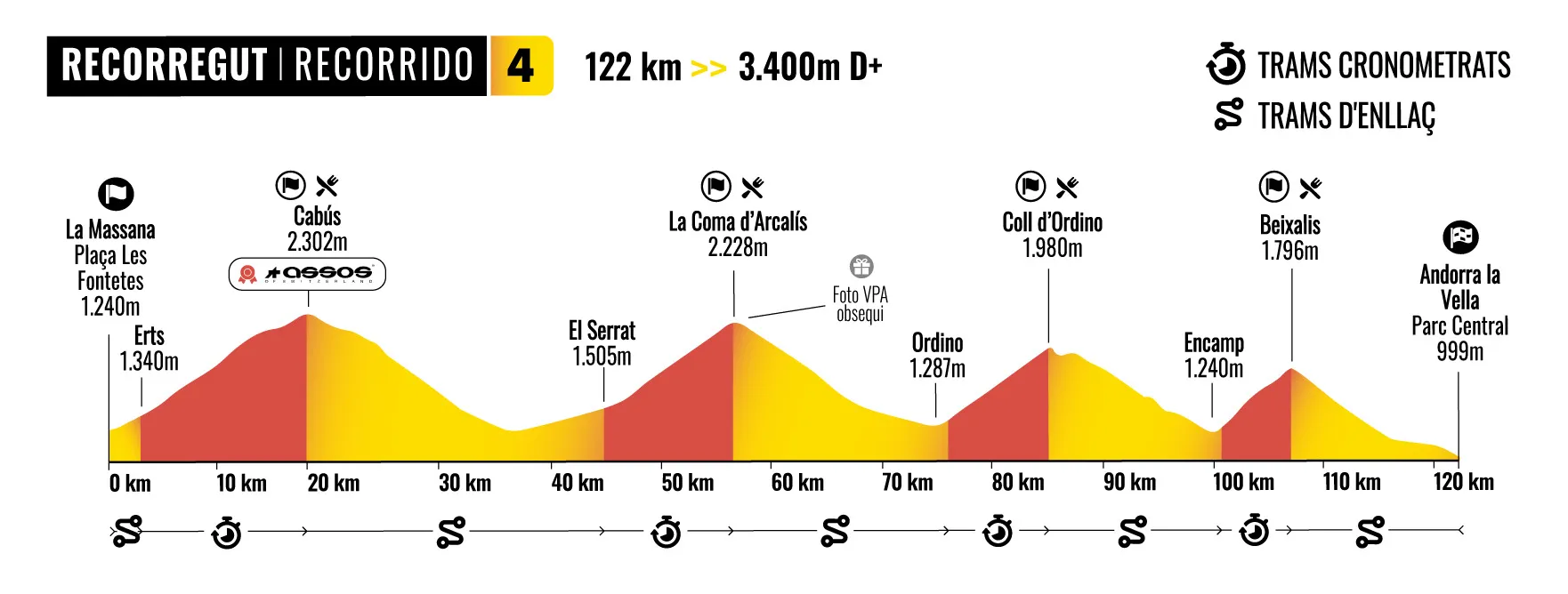
Route 4* — 122 km / 3,400 m elevation gain, with the same sections as route 3 plus a fourth one that goes from Erts to Puerto de Cabús.
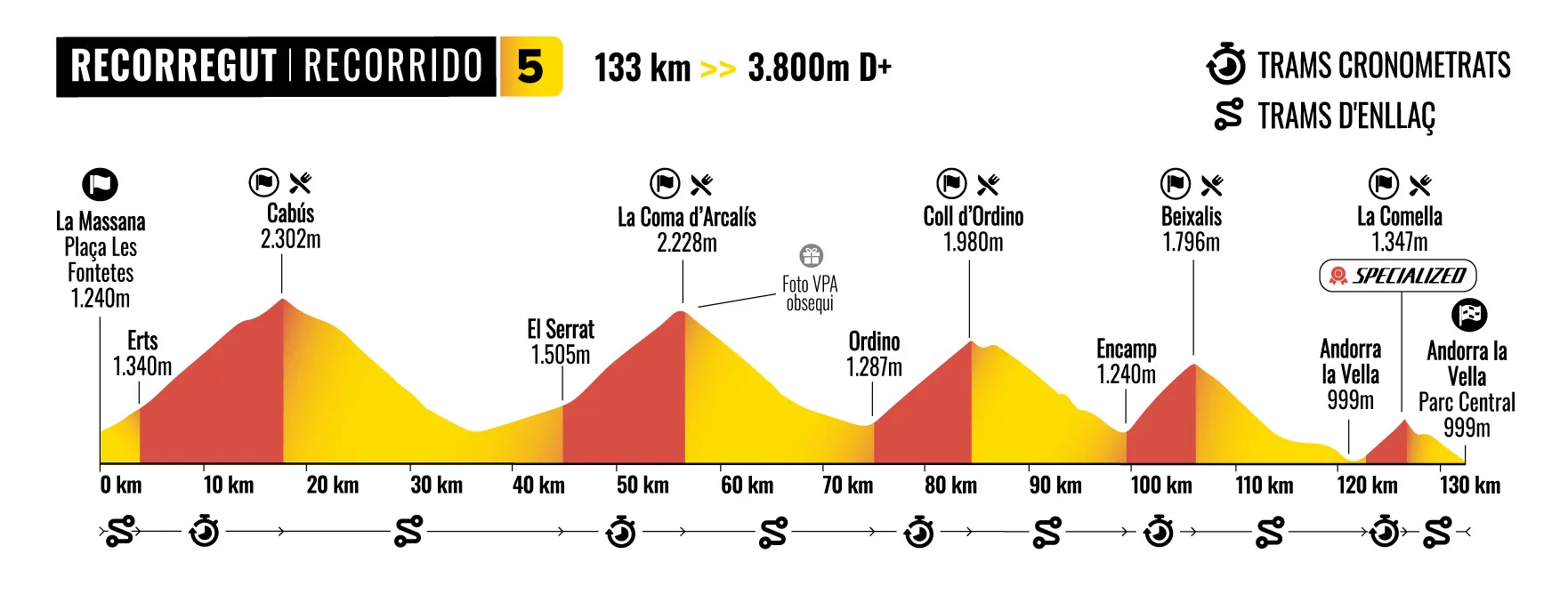
Route 5* — 133 km / 3,500 m elevation gain, with the same sections as route 4 plus a fifth from Andorra la Vella to Alto de la Comella.
Route Summary Table
Route | Distance | Elevation Gain | Timed Climbs | Start |
|---|---|---|---|---|
1 star | 52 km | 1,080 m+ | Arcalís | 9:00 h |
2 stars | 69 km | 1,760 m+ | Arcalís + Coll d'Ordino | 9:00 h |
3 stars | 87 km | 2,320 m+ | + Beixalís | 8:30 h |
4 stars | 122 km | 3,400 m+ | + Cabús | 8:30 h |
5 stars | 133 km | 3,500 m+ | + La Comella | 8:00 h |
Which route to choose based on your level?
The route 1 is designed for cyclists who are new to the Volta or who come to enjoy the atmosphere without obsessing over the classification. Only one timed climb, and the rest is a relaxed experience through the valleys of Andorra.
The routes 2 and 3 are suitable for the average cyclist with a good aerobic base. Route 3 in particular —with Arcalís, Ordino, and Beixalís— already represents a tough but very satisfying day.
The routes 4 and 5 are for experienced cyclists who know the country or come specifically to challenge themselves on Andorra's most demanding climbs. The 5-star route, with the Alto de la Comella at the end after 130 km in the legs, is an exercise in effort management as much as power.
The innovative format: only climbs are timed
This is the detail that most distinguishes the Volta als Ports from other major cycling events on the European calendar.
In this format, all participants start together from La Massana, but only the ascents count as timed sections. The sum of the times from the timed sections determines the final time and classification according to the selected route. The linking sections are not timed and do not count towards the classification, which allows participants to enjoy the descents and aid stations without rush or stress.
What this means in practice: you can descend from Coll d'Ordino calmly, chat with other cyclists, eat well at the aid station, and arrive perfectly recovered to tackle the next climb. There is no racing on the descents, which in Andorra can be technical and require concentration. It's a smart decision in terms of safety, and it also makes the event infinitely more enjoyable.
To complete the event, once the last timed section is finished, it is mandatory to reach the finish line at Central Park in Andorra la Vella to be considered a finisher of the JORMA Volta als Ports d'Andorra and to be eligible for the classification of each route.
Finisher medals are divided into three categories —gold, silver, and bronze— based on the total time in the timed segments. The top three men and women of each route receive awards at the finish line ceremony.
Registration fees 2026
The registration period runs from December 19, 2025 to July 16, 2026.
Attention: prices increase on July 1, 2026.If you haven't registered yet, you have a few days left to do so at a preferential rate.
Current rates (until June 30, 2026) are as follows:
- Route 1*: 49 €
- Route 2*: 54 € (increases to 64 € on July 1)
- Route 3*: 59 € (increases to 69 € on July 1)
- Route 4*: 64 € (increases to 74 € on July 1)
- Route 5*: 69 € (increases to 79 € on July 1)
- Training Pack 4* + jersey: 100 €
- Training Pack 5* + jersey: 100 €
- Social Ride ASSOS Collective 13: free
The official event jersey is optional and can be added during the registration process. Registrations are managed through the official website voltaalsports.com and the AvaiBook Sports portal.
Weekend Program: Saturday, July 18 and Sunday, July 19
The Volta als Ports is not just about race Sunday. The entire weekend has its own rhythm.
Saturday, July 18 — Expo and bib collection
On Saturday, July 18, bib collection and pre-activities take place. The expo is set up in the Plaça de les Fontetes de La Massana, where participants and their companions will find stands from collaborating brands —Specialized, Trek, Orbea, Megamo among others— and hourly raffles among all attendees. It's the ideal time to try out gear, talk to brand technicians, and get into the event atmosphere.
If you plan to arrive on Friday to acclimatize to the altitude (La Massana is about 1,240 meters high), even better. Andorra in July has a cultural and activity agenda that offers much more than just cycling: check out our guide to events and activities in Andorra to make the most of the weekend.
Sunday, July 19 — Event Day
Starts are staggered according to the chosen route, beginning at 8:00 AM for the 5-star route. All participants depart from Plaça de les Fontetes and follow the route to Andorra la Vella.
On Sunday, at Parc Central, the finish line village is set up with various service areas for participants and their companions.
The mountain passes: what awaits you on each climb?
Andorra concentrates some of the toughest passes in the Pyrenees within a territory of just 468 km². The Volta als Ports links them in a way that, depending on the chosen route, can be a demanding ride or an absolutely epic day.
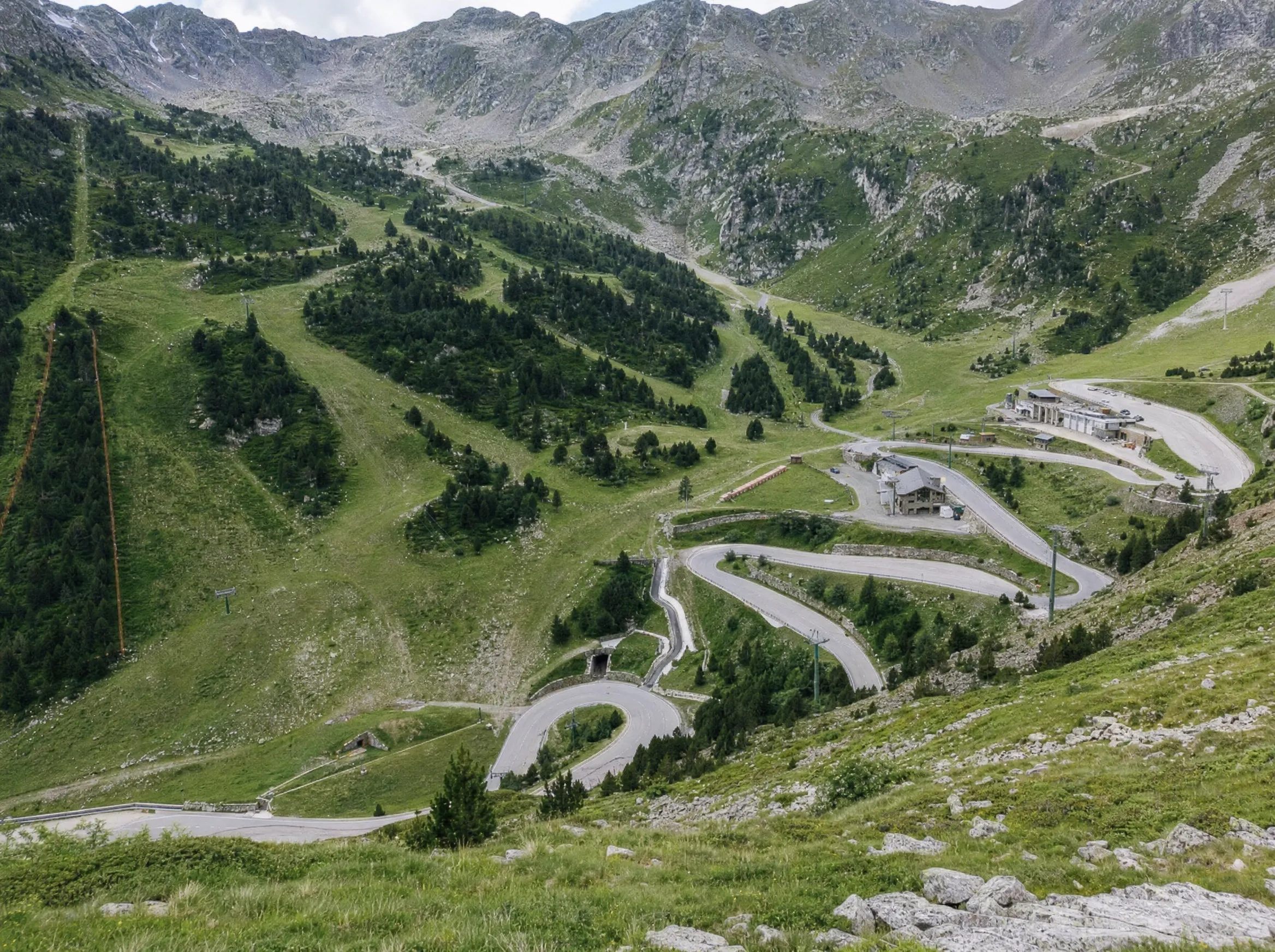
Coma d'Arcalís (present on all routes)
The longest climb of the event. It starts from Serrat, in the Tristaina valley, and ascends to 2,240 meters at Coma d'Arcalís, in the parish of Ordino. It's a pass that professionals know well: it's one of the most spectacular stage finishes that pass through Andorra. Average gradient of 6%, with ramps of 10% near the summit. The views over the Circo de Tristaina justify the suffering.
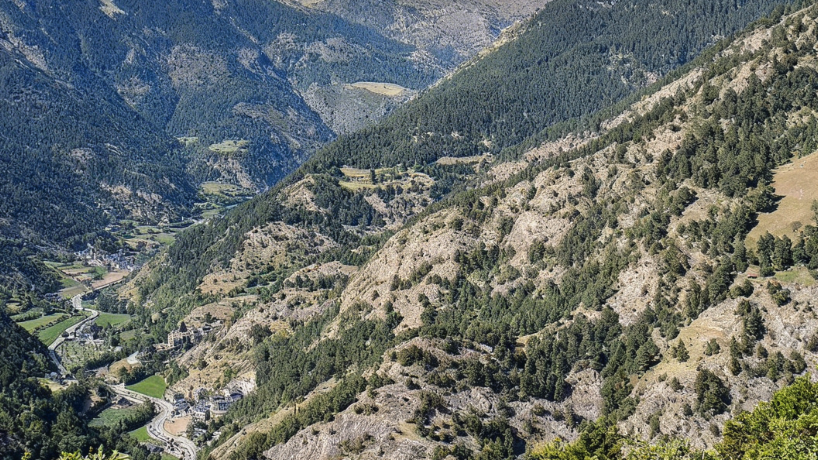
Coll d'Ordino (routes 2, 3, 4 and 5)
An Andorran cycling classic. It climbs from the village of Ordino to 1,980 meters at the pass, with an irregular profile and several sections at 8-9%. It's a pass that seems simple on the map but holds surprises on the last ramps, especially if Arcalís has already been climbed.
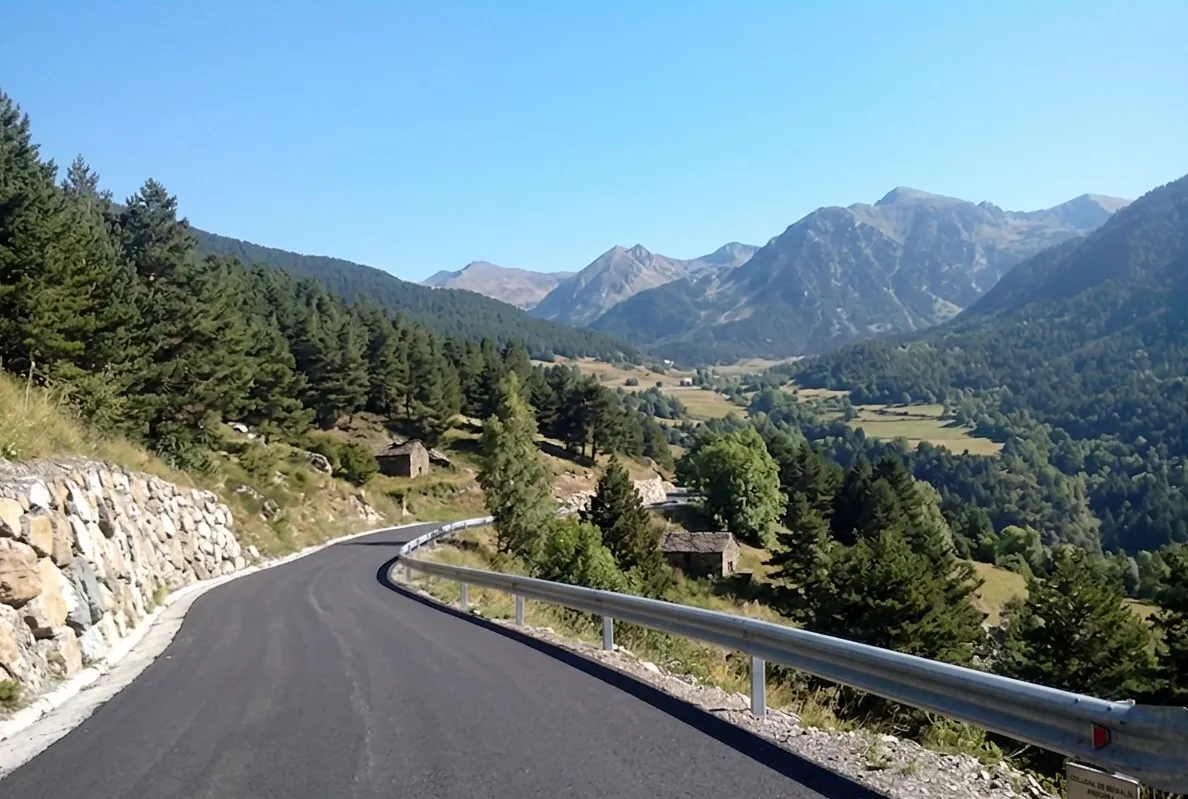
Puerto de Beixalís (routes 3, 4 and 5)
The climb from Encamp to Beixalís is technical and tough. It starts with very irregular ramps when leaving the urban area and progressively increases in gradient. Miquel Induráin climbed this pass in the 1993 Tour de France. That says it all.
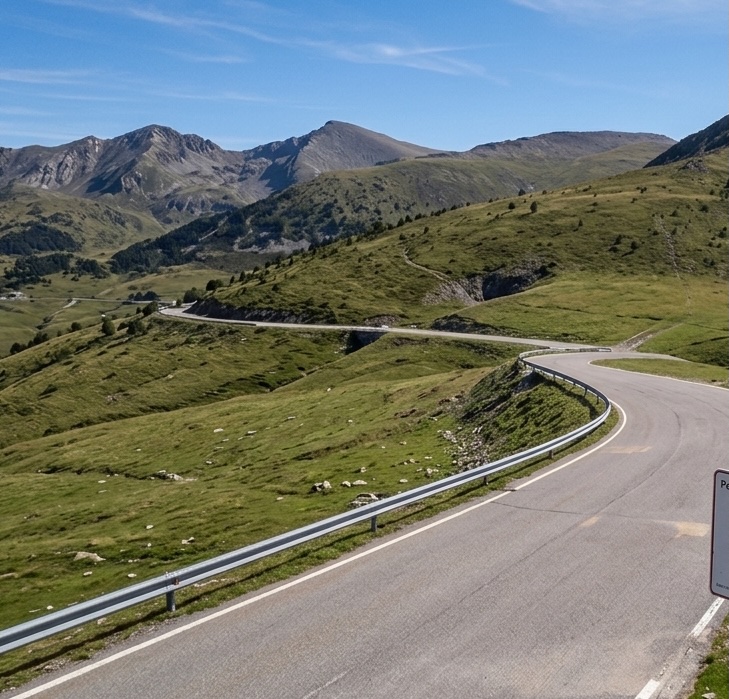
Port de Cabús (routes 4 and 5)
It starts from Erts, in the parish of La Massana, and climbs up to Port de Cabús, which marks the border with the Catalan Pallars Sobirà. A long pass, with a sustained gradient, which appears relatively late in route 4 and takes a considerable physical toll. Cyclists competing in 4-star events must manage their nutrition well to arrive in good condition.
Alto de la Comella (route 5 only)
The fifth and last timed section of the longest route. It starts from the center of Andorra la Vella and climbs up to Alto de la Comella, at about 1,600 meters. It is not the hardest in terms of elevation gain, but it comes after more than 120 km and 3,000 meters of accumulated ascent. It is the perfect culmination—or the ultimate torment, depending on the state of your legs—for the brave riders of the 5-star route.
You can also discover these and other corners of the country in our section on Andorra destinations.
Services at the finish line: what's at Parc Central
Arriving at Parc Central in Andorra la Vella is not just crossing the finish line. In the arrival paddock, you can collect your finisher's medal (gold, silver, or bronze) and, if you've made it to the podium on your route, you'll receive your award in the same area for the top three men and women in each category. The time for medal awarding is calculated only on the times of the timed sections.
Other services available at the finish line:
- Massage service: the Cefel school offers massages for all participants.
- Lunch area: participants receive a meal ticket for participating restaurants in the area. Companions can purchase their ticket at the paddock.
- Bike Park: an area set up to leave your bike supervised while you rest or eat.
- Free bus: return bus service from the Andorra la Vella paddock to La Massana (Prat del Colat).
The free bus is a very practical detail that many participants don't know about: it solves the logistical problem of retrieving your car in La Massana without complications.
How to get there and where to park
La Massana is 7 km from Andorra la Vella via the CG-4. Access from Spain is mainly via Pas de la Casa or via the Envalira Tunnel from France. From Barcelona, it's approximately a 3-hour drive.
On race day, La Massana concentrates many cars. The most convenient option is to park in the municipality itself (there are public car parks next to the center) or in Andorra la Vella and travel by public transport. The free return bus solves the return journey from the finish line.
For any questions about mobility within Andorra, in our Plan Your Trip section you have all the updated information.
Where to stay: accommodation for the Volta als Ports
The Volta als Ports fills up accommodation in La Massana and Andorra la Vella every year. Cyclists arriving on Friday or Saturday to pick up their bib and acclimatize have access to options for all budgets, from hotels with spa ideal for muscle recovery to apartments with kitchens and bike parking.
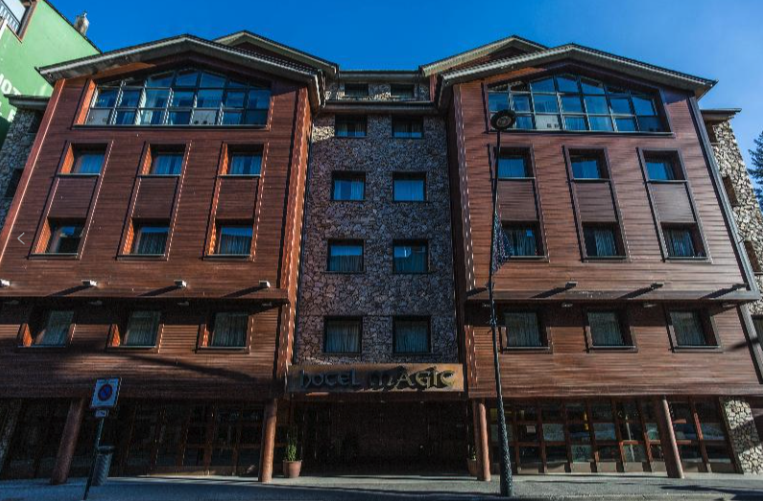
Where is it best to stay?
- La Massana: the most practical option if you want to start rested from the starting square itself. The parish has a wide range of hotels and a quiet atmosphere.
- Ordino: a few minutes from La Massana, more intimate and generally with slightly lower prices. Ideal for groups.
- Andorra la Vella: central, with easy access to restaurants and shops. Practically at the finish line, although logistics on race day require a bit of planning.
Check accommodation availability and book your stay in advance. Hotels for the weekend of July 18-20 fill up early: don't leave it until the last minute.
The Volta als Ports is the kind of event that deserves to become a two or three-day getaway. Andorra in July has enough sports and cultural offerings so that Sunday is not the only plan for the weekend.
Practical tips for preparing for the Volta als Ports
Living in Andorra for years—or simply having cycled it from end to end—gives you perspective on what makes the difference between an epic day and a day of survival. Here are the most important ones:
On physical preparation:
- If it's your first time and you've chosen the 3-star or higher route, include at least one ride with more than 2,000 meters of elevation gain in the weeks prior. The accumulation of passes hits very differently than a single long climb.
- Arriving one or two days before and riding gently (40-60 minutes) at altitude helps with adaptation. Andorra la Vella is at 1,023 meters, and Arcalís exceeds 2,200. The difference is noticeable.
On nutrition during the race:
- The Volta's aid stations are plentiful, but don't rely exclusively on them. Carry at least 2-3 of your own gels or bars in case the liaison sections take longer than expected.
- Drink before you get thirsty, especially in July. Temperatures in the valleys can exceed 25°C.
About the equipment:
- Andorran descents have tight curves. If you don't know the passes, descend cautiously. Safety is more important than gaining time on non-timed sections.
- Bring a windbreaker for the summit of Arcalís. At over 2,200 meters in July, it can be cold or windy, especially if you're waiting for others at the top.
About logistics:
- Pick up your race bib on Saturday without fail. There is no pickup on race day.
- If you come with a companion who wants to see the finish, Parc Central has free access and the atmosphere is great.
- Sign up for the Saturday raffle at the expo: they are held every hour and the prizes are worth it.
Common mistakes to avoid
- Signing up for an overly ambitious route: The 4 or 5-star route with 3,400-3,500 meters of elevation gain is a serious challenge. If your longest ride of the year has 1,500 meters, start with the 2 or 3-star route.
- Ignoring the cut-off time: Each route has a maximum time. Route 1 closes at 4 hours; route 2 at 5 hours and 30 minutes. After that time, participants still on liaison sections must go directly to the finish line. Manage your effort well from the first climb.
- Underestimating the heat: July in Andorra can be warm in the valleys and cold in the passes. The thermal difference between the start and the summit of Arcalís can be 10-15°C. Adapt your gear.
- Not booking accommodation in advance: Hotels in La Massana and Andorra la Vella are booked weeks in advance for this weekend. If you're reading this a few weeks before the event, act fast.
You can book your accommodation directly on Andorra.com:
Frequently asked questions
You may be interested in