In this article
- Why visit the church of Sant Julià i Sant Germà
- Where it is and what it represents for Sant Julià de Lòria
- History of the church: from Romanesque to the present day
- Don't know where you're going to stay?
- What to see outside
- The Lombard bell tower
- The facade and the urban contrast
- What to see inside
- Altarpieces, carvings, and devotional pieces
- The contemporary mosaics
- How to visit the church of Sant Julià i Sant Germà
- Recommended route through Sant Julià de Lòria
- Local tips for the visit
- Activities you can do in Sant Julià de Lòria
- Frequently asked questions
The church of Sant Julià i Sant Germà is one of the most important temples in Sant Julià de Lòria and a key stop to understand the Romanesque, religious tradition, and local life of southern Andorra. It is located on Avinguda Verge de Canòlich, in the center of the town, and preserves its three-story Lombard bell tower as a great Romanesque element.
In this guide, you will find what to see, why it is worth visiting, how to integrate it into a route through Sant Julià de Lòria, and what tips to keep in mind to enjoy it at your leisure.
Why visit the church of Sant Julià i Sant Germà
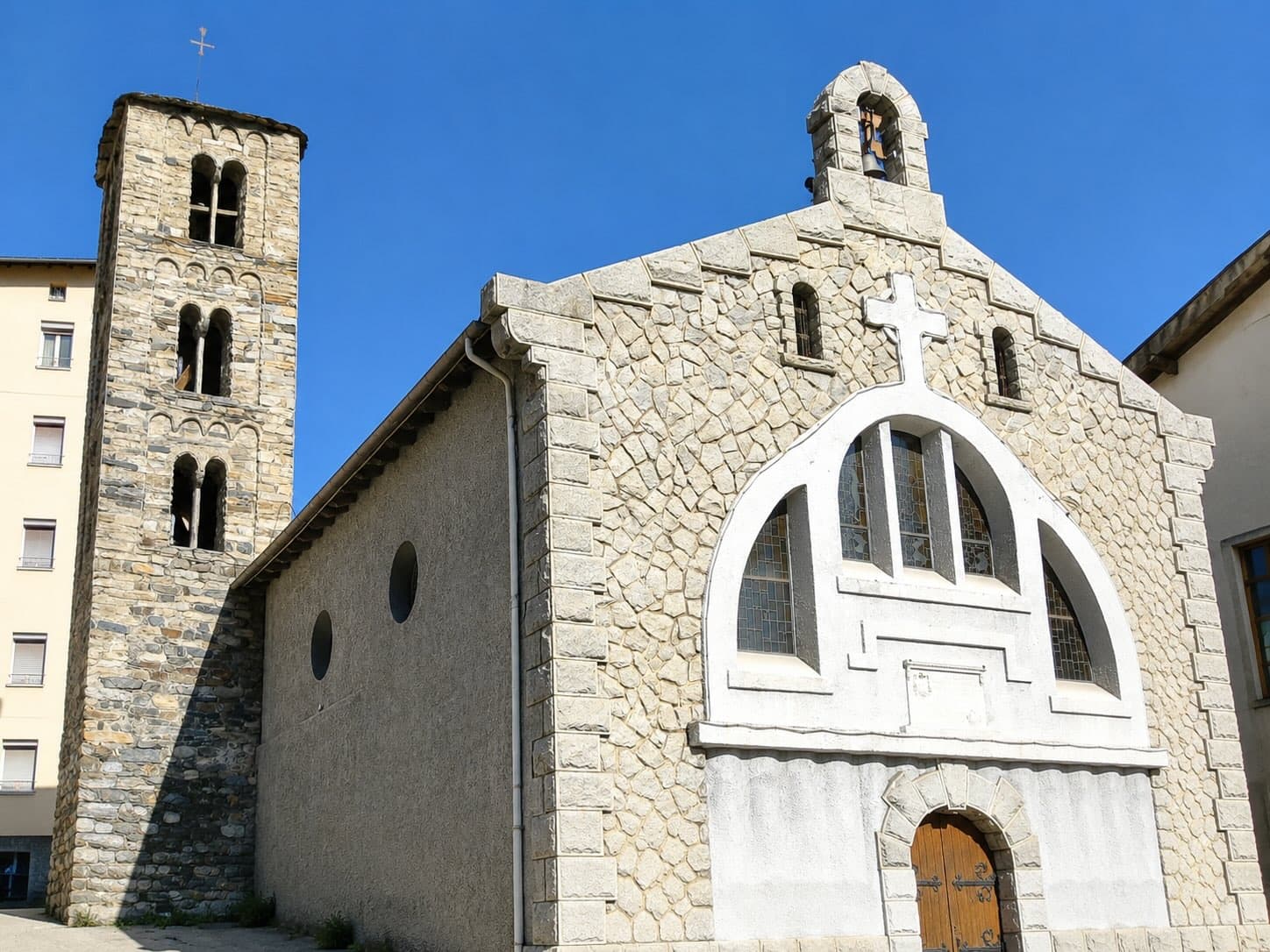
If you are looking for what to see in Sant Julià de Lòria, this church is one of the most direct, accessible, and representative visits. It is not an isolated monument in the mountains: it is part of the daily life of the town. That is precisely its strength.
Here, three layers of history coexist: the Romanesque origin, the Baroque transformations, and the contemporary intervention of the presbytery mosaics. The primitive construction was extensively restored and reformed, but the three-story Lombard bell tower remains the great medieval testimony of the complex.
For the traveler, the visit works very well as a first cultural stop before continuing to other places of interest in Sant Julià, such as Sant Serni de Nagol, the sanctuary of Canòlich, or the Tomb Lauredià itineraries.
Where it is and what it represents for Sant Julià de Lòria
The church is located at Avinguda Verge de Canòlich, 30, in Sant Julià de Lòria, a parish located in the south of the country and considered the gateway to Andorra when approaching from Catalonia.
Sant Julià de Lòria preserves a very distinct identity: it is a border, a valley, popular tradition, and religious heritage. In the urban center, the church of Sant Julià i Sant Germà acts as a visual and symbolic reference point. You don't have to look too hard for it: the bell tower appears among everyday buildings, shops, and thoroughfares, reminding us that Andorran heritage is often best understood by walking unhurriedly.
The parish stands out for its cultural richness, with examples of Romanesque architecture such as Sant Serni de Nagol and spaces of strong devotional value such as the sanctuary of Canòlich.
History of the church: from Romanesque to the present day
The church of Sant Julià i Sant Germà is of Romanesque origin, although the current building is the result of various renovations. Of the original construction, the bell tower, described as Lombard, square, massive, and three-storied, is particularly preserved.
This detail is important to avoid a common mistake: not everything we see today belongs to the same era. In Andorra, many churches have evolved over centuries, adapting to new liturgical, artistic, and community needs. The country preserves more than 40 churches, chapels, and monuments linked to rural Romanesque, ancient centers of religious and social gathering.
In Sant Julià i Sant Germà, this evolution is clearly perceived: the bell tower takes us to the Romanesque; the altarpieces and devotional pieces speak to us of the Baroque; and the mosaics installed in 2019 provide a contemporary reading of the liturgical space.
Don't know where you're going to stay?
If you haven't chosen accommodation for your stay yet,
here are some recommendations that might suit you.
What to see outside
The Lombard bell tower
The most valuable exterior element is the three-story Romanesque bell tower. It is the oldest vestige of the complex and the feature that connects the church with the architectural tradition of Andorran Romanesque.
Notice its verticality, the stone, and the sobriety of its volume. It is not a monumental bell tower in the urban sense of a grand cathedral, but an example of mountain religious architecture: practical, resistant, and deeply integrated into the built landscape of the town.
The facade and the urban contrast
The current facade combines stone, simple lines, and a very recognizable entrance. The interesting thing, from my point of view, is to observe how the temple dialogues with contemporary Sant Julià. It is on a lively avenue, not a tourist set. This mix of heritage and daily life is one of the keys to the visit.
What to see inside
Altarpieces, carvings, and devotional pieces
Inside, elements of great religious and artistic interest are preserved. These include Baroque altarpieces dedicated to Sant Julià, the Immaculate Conception, and Sant Germà, as well as carvings such as the Virgin of Canòlich and the Virgin of Remedies, both linked to the devotional heritage of the parish.
The presence of the Christ of Grace and other pieces that help understand the continuity of local faith through the centuries are also mentioned.
The contemporary mosaics
Since May 2019, the church has featured some 200 m² of mosaics in the main altar and presbytery. The intervention contributed to beautifying the main space and creating a dedicated chapel for the Virgin of Canòlich, patron saint of Sant Julià de Lòria.
The mosaics depict a Pantocrator, scenes of Jesus with the evangelists, the Virgin Mary, and other figures from Catholic iconography.
My recommendation is not to just enter “to see a church.” Enter with a few minutes to spare, sit at the back, and let your eyes adjust to the light. The contrast between the exterior sobriety and the interior color is one of the temple's best surprises.
How to visit the church of Sant Julià i Sant Germà
The church maintains daily ecclesiastical activity, so it is advisable to respect worship times and confirm schedules before organizing your visit.
The Sant Julià de Lòria Tourist Office is in Plaça Laurèdia and offers practical information for visitors.
Additionally, the temple has adapted access for people with reduced mobility.
Recommended route through Sant Julià de Lòria
The church of Sant Julià i Sant Germà can be visited as part of a small cultural route through the parish. This is a simple proposal for a morning or an afternoon:
Stop | Why it's worth it |
Church of Sant Julià i Sant Germà | Spiritual and heritage center of the town |
Plaça Laurèdia | Practical point for orientation and contacting tourism |
Cóms Fountain | Popular heritage linked to the old path to La Seu d’Urgell |
Sant Serni de Nagol | Romanesque church from 1055 with valley views |
Sanctuary of Canòlich | Key devotional space for Lauredian identity |
Sant Serni de Nagol is documented as a church from the year 1055 and is one of the outstanding examples of the parish's Romanesque heritage. The sanctuary of Canòlich, for its part, is located at an altitude of 1,635 meters and hosts a popular day of devotion to the Virgin of Canòlich every last Saturday of May.
This combination allows understanding Sant Julià from three perspectives: the town, the Romanesque, and living tradition.
Local tips for the visit
1. Don't visit in a hurry.
It's a small church, but it holds a lot of historical information. In 15 or 20 minutes you can see it; in 40 minutes you can understand it.
2. Look at the bell tower from outside first.
Before entering, cross the street and observe the volume of the bell tower. It is the piece that best preserves the Romanesque memory of the building.
3. Avoid interrupting celebrations.
It is still an active religious space. If it coincides with mass or a liturgical act, wait or only visit the exterior.
4. Combine it with a route through Sant Julià.
The church gains meaning when you connect it with Canòlich, Sant Serni de Nagol, and the rest of the Lauredian heritage.
5. Base yourself in the parish if you want to take your time.
If your trip combines culture, nature, and towns in southern Andorra, sleeping nearby can be a practical option. See hotels in Sant Julià de Lòria.
Activities you can do in Sant Julià de Lòria
Frequently asked questions
You may be interested in

Most read