
In this article
- What are the Tears of Saint Lawrence and why is 2026 an exceptional year?
- Why is 2026 especially good for viewing them?
- Why is Andorra one of the best destinations in the Pyrenees to see the Perseids?
- La Massana's Starlight certification: the scientific endorsement
- Altitude and low light pollution
- The best viewpoints and observation spots in Andorra
- Coll de la Botella (Pal, La Massana) — Certified Starlight Reserve
- Roc de la Sabina (Arinsal, La Massana) — accessible and with astronomical equipment
- Llac d'Engolasters (Escaldes-Engordany) — stars reflected in the water
- Roc del Quer parking area (Canillo) — views of the Valira d'Orient
- Sorteny Valley Natural Park (Ordino) — for hikers
- Madriu-Perafita-Claror Valley — UNESCO heritage for experts
- What organized activities are there in Andorra to see the Perseids in 2026?
- Guided astrotourism excursions in La Massana (Coll de la Botella)
- Astrophotography workshops
- When and how to observe the Perseids? Practical tips
- The best time to see them
- The necessary equipment (and what is not needed)
- How to adapt your vision to darkness
- Where to look at the sky
- How to photograph the Perseids in Andorra? Basic guide
- Common mistakes when observing the Perseids
- Where to stay in Andorra to see the Perseids?
- Frequently Asked Questions
The night of August 12-13, 2026 brings together three astronomical phenomena at once: the Perseid peak, the new moon, and, hours before, a total solar eclipse visible from Spain. The National Geographic Institute (IGN) places the peak of greatest activity between 4:00 and 6:00 AM on August 13, with a completely dark sky thanks to the lunar phase. Andorra, with the Starlight certification from La Massana and some of the darkest skies in Southern Europe, offers observation conditions difficult to match in the Pyrenean environment. In this article, you will find the best viewpoints classified by accessibility, available organized activities, practical tips for beginners, and a basic guide to night photography.
What are the Tears of Saint Lawrence and why is 2026 an exceptional year?
The Tears of Saint Lawrence is the popular name for the Perseids, a meteor shower that occurs every year when Earth crosses the path of comet 109P/Swift-Tuttle. The dust and rock particles left by the comet enter the Earth's atmosphere at more than 50 kilometers per second and disintegrate, generating the luminous streaks we know as shooting stars. Its name comes from the feast day of Saint Lawrence, August 10, a date close to the shower's annual peak.
The Perseids are active between July 17 and August 24, but the most intense activity is always concentrated in the middle of the month. Their apparent point of origin —the radiant— is located in the constellation Perseus, in the northeast direction.
Why is 2026 especially good for viewing them?
In 2026, three circumstances coincide that very rarely occur at the same time:
The new moon. The new moon will take place on the evening of August 12, 2026, according to the IGN. This means that during the night of the Perseid peak, the sky will be completely dark, without lunar interference. Weaker meteors, which go completely unnoticed in full moon years, will be visible from places with low light pollution.
The solar eclipse. Hours before the Perseid peak, on August 12, the first total solar eclipse visible from the Iberian Peninsula in over a century will occur. The newspaper El País described this coincidence as "a cosmic gift so rare that the last time it happened, Neanderthals were still walking through Europe." For those visiting Andorra that day, the day can combine observing the eclipse in the afternoon —with the mandatory approved glasses— and the meteor shower starting at midnight. (Note to editor: verify with official sources whether Andorra is within the path of totality or partiality of the eclipse, and the exact local visibility time.)
The peak and optimal hours. According to the IGN, the 2026 Perseid peak will occur between 4:00 and 6:00 AM on August 13, although activity will already be intense from 11:00 PM on the 12th. Under ideal conditions of dark sky and no light pollution, the Zenithal Hourly Rate (ZHR) can reach between 100 and 120 meteors per hour; under real conditions, it is most common to observe around 50.
Why is Andorra one of the best destinations in the Pyrenees to see the Perseids?
Andorra combines three advantages that are scarce in surrounding tourist destinations: high altitude, low urban density, and a territory protected from the light pollution of large metropolitan areas.
La Massana's Starlight certification: the scientific endorsement
On January 10, 2023, the Starlight Foundation awarded the parish of La Massana the Double Starlight Certification: Starlight Tourist Destination for the entire parish and Starlight Reserve for the Comapedrosa Natural Park. Antonia Varela, doctor in astrophysics and director of the Starlight Foundation, noted that the sky quality of Comapedrosa "is on par with major international observatories." The cònsol major of La Massana, Olga Molné, summarized the recognition with a direct phrase: "In La Massana, we have the darkest sky in the entire country and one of the best in Southern Europe."
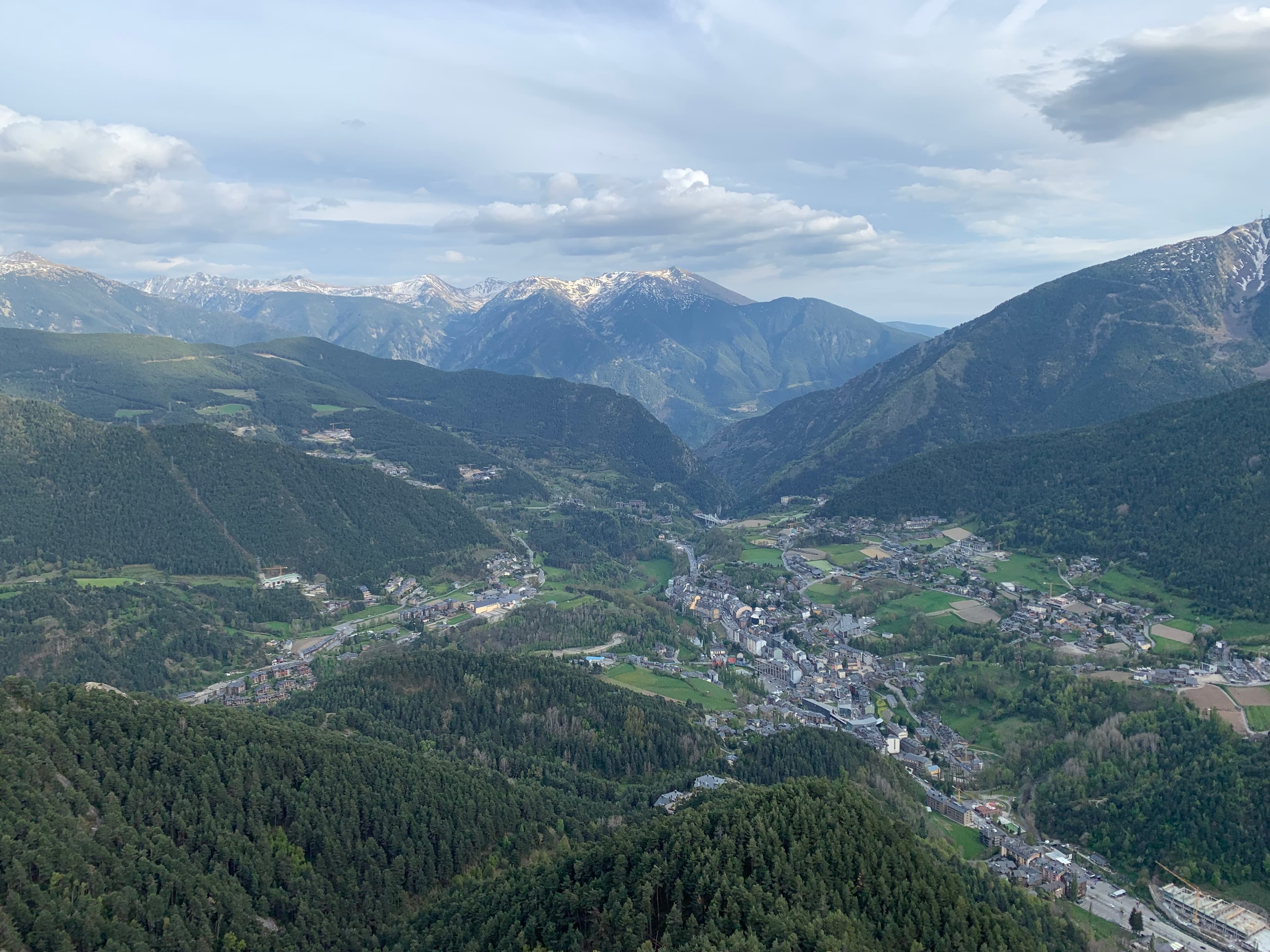
This international seal, endorsed by UNESCO and the UNWTO, certifies that the territory meets strict criteria for night sky quality and that its lighting infrastructures respect the environment. La Massana uses warm-toned lighting directed towards the ground, which minimizes light dispersion towards the upper hemisphere of the sky.
Altitude and low light pollution
The main astronomical observation viewpoints in Andorra are located between 1,500 and 2,115 meters of altitude. At higher altitudes, there is less atmospheric thickness, less humidity, and less influence from valley lighting. The low population density and territorial distribution in small nuclei mean that, a few kilometers from any point in Andorra, the sky is notably darker than in surrounding cities.
The best viewpoints and observation spots in Andorra
Below are the verified observation points, classified by accessibility level. For each one, the parish, approximate altitude, how to get there at night, and for which visitor profile it is most suitable are indicated.
Location | Parish | Approx. altitude | Night access | Level | Ideal for |
Coll de la Botella | La Massana | ~2,115 m | By car | Easy | All profiles |
Roc de la Sabina | La Massana | 1,896 m | By car (CS-520) | Easy | Families, photographers |
Llac d'Engolasters | Escaldes-Engordany | ~1,500 m | Car + short walk | Easy | Families, couples |
Roc del Quer Parking Area | Canillo | ~1,700 m | Car (km 6.5 CS-240) | Easy | Adults, reduced mobility |
Sorteny Valley Natural Park | Ordino | ~1,900 m | Car + 30 min. walk | Moderate | Hikers |
Madriu-Perafita-Claror Valley | Andorra la Vella / Escaldes | Variable | 2 h walking | Expert | Experienced hikers |
Coll de la Botella (Pal, La Massana) — Certified Starlight Reserve
Coll de la Botella is the benchmark for astrotourism in Andorra. It is located at an altitude of approximately 2,115 meters, in the parish of La Massana, and features astronomical tables that allow for the identification of constellations and planets. Being situated within the Starlight Reserve of Comapedrosa Natural Park, it offers one of the darkest skies in the country.
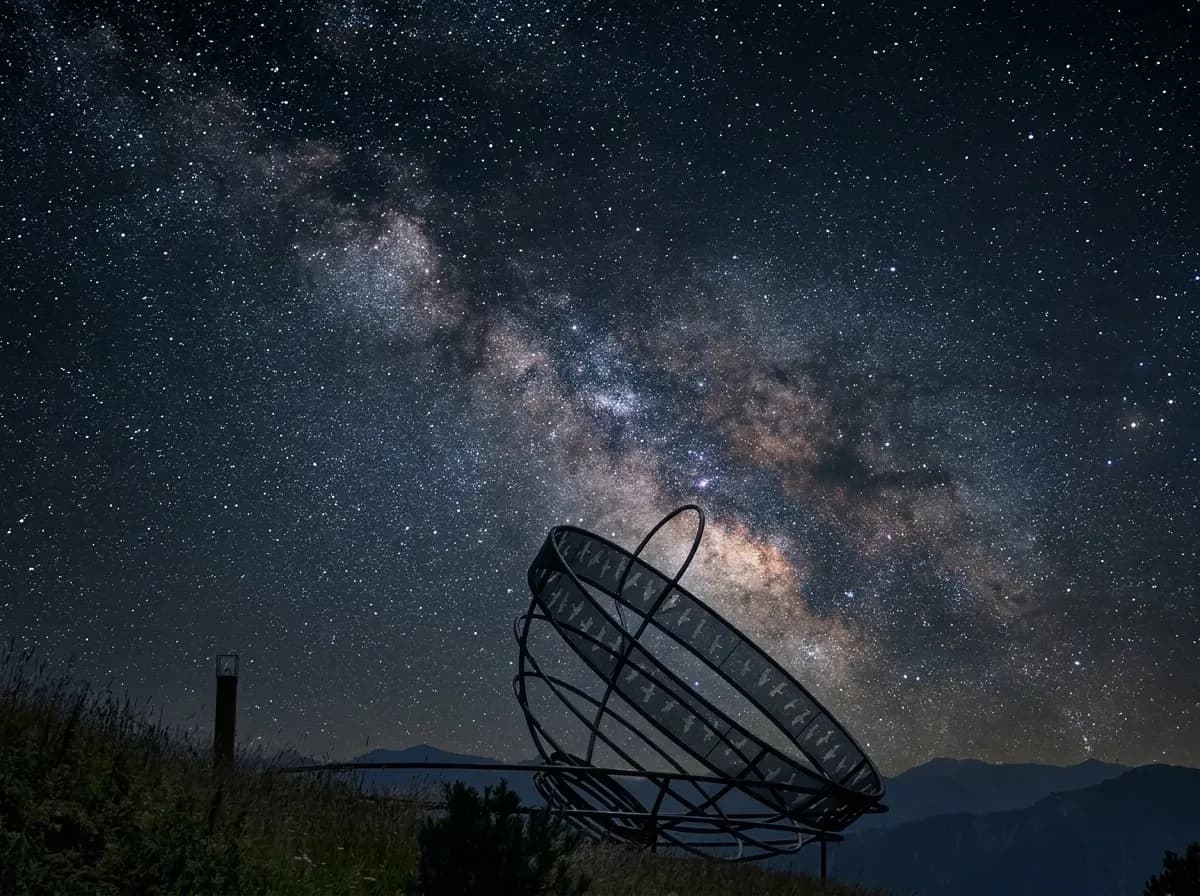
Access is easy by car. It is the only point in Andorra with guided observation activities led by certified Starlight monitors, organized by the Comú de La Massana (see activities section). Suitable for all profiles: families with children, adults with no astronomy experience, and photographers.
Roc de la Sabina (Arinsal, La Massana) — accessible and with astronomical equipment
The Roc de la Sabina viewpoint is located at 1,896 meters above sea level, on the CS-520 road from Arinsal. It features astronomical tables and offers panoramic views of the Comapedrosa Natural Park. Being within La Massana's Starlight territory, it has very low light pollution.
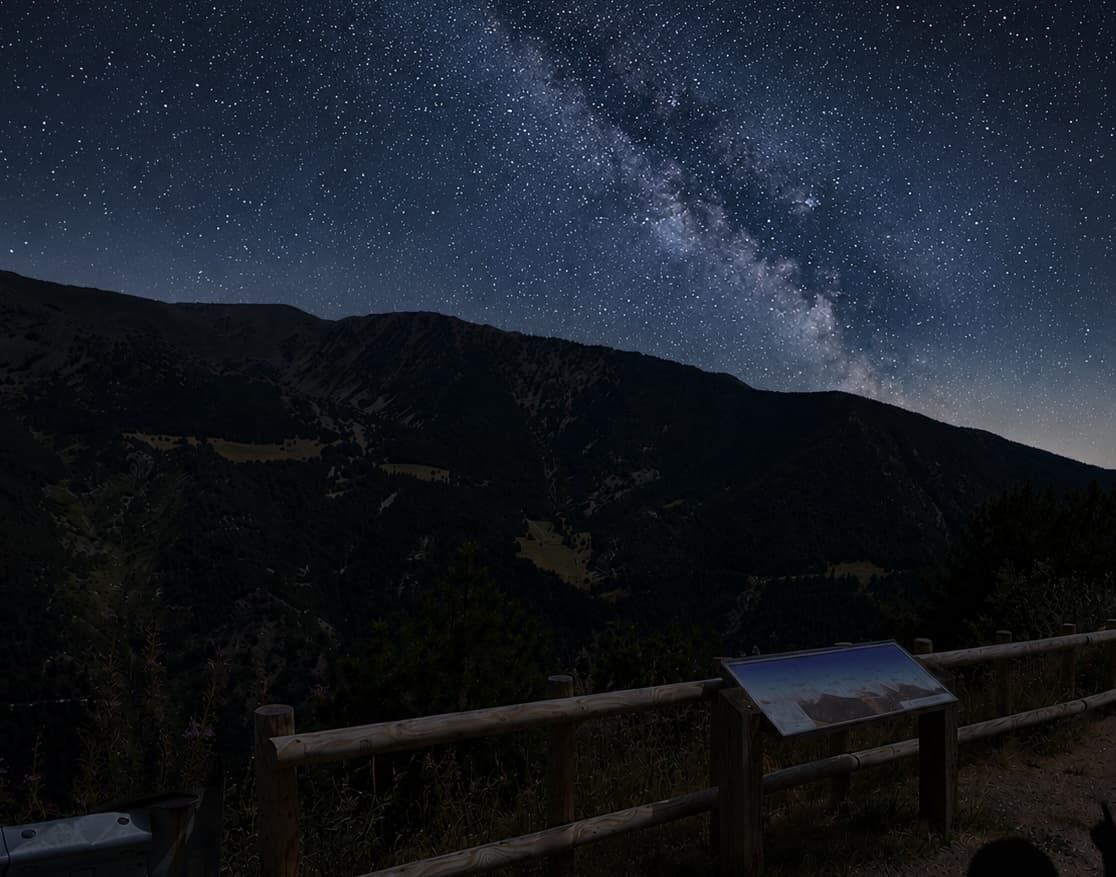
It is one of the most accessible spots in Andorra for night observation: it can be reached directly by car and requires no walking. Ideal for families and those looking for a simple and well-marked location.
Llac d'Engolasters (Escaldes-Engordany) — stars reflected in the water
The Engolasters Lake is an artificial reservoir located at approximately 1,500 meters of altitude in Escaldes-Engordany, which feeds Andorra's hydroelectric power plant. Its calm surface reflects the night sky, making it one of the most photogenic settings in the country for astrophotography.
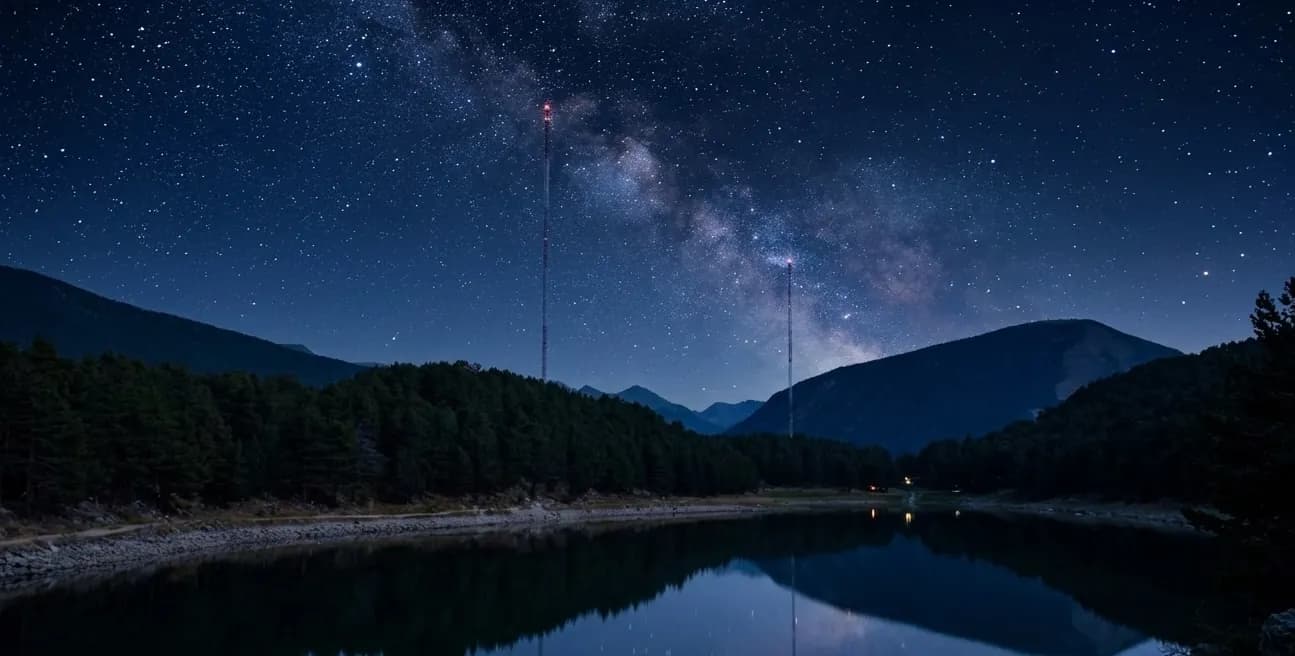
Nearby is the Romanesque church of Sant Miquel d'Engolasters, declared a Cultural Asset of Interest, from which views of the valley can be enjoyed. At 1,500 meters, it is somewhat more exposed to light pollution from the valleys than the spots in La Massana, but it is still a quality location for observation.
Roc del Quer parking area (Canillo) — views of the Valira d'Orient
Roc del Quer is one of Andorra's most visited viewpoints, inaugurated in 2016: a 20-meter long metal walkway (12 of which are suspended 500 meters high in the air, with a glass floor), offering views over the Montaup and Valira d'Orient valleys. It is located at kilometer 6.5 of the CS-240 road, in Canillo.
The viewpoint has opening hours (from 10 AM to 6 PM) and remains closed at night. However, the parking area, with an open sky and wide views of the valley, is a valid alternative for night observation. (Note to editor: confirm with the Comú de Canillo if the parking is freely accessible during the night of August 12-13.)
Sorteny Valley Natural Park (Ordino) — for hikers
The Sorteny Valley Natural Park, in Ordino, spans over 1,000 hectares and is Andorra's largest protected natural area. It offers a very dark sky away from urban centers, but requires an approximately 30-minute walk from the nearest car park into the park.
Access to the park's car park is subject to a fee during July and August. For hikers experienced in night routes, it represents one of Andorra's quietest and most isolated options.
Madriu-Perafita-Claror Valley — UNESCO heritage for experts
This glacial valley, located between Encamp, Andorra la Vella, Sant Julià de Lòria, and Escaldes-Engordany, is Andorra's only cultural landscape declared a UNESCO World Heritage Site. Its remoteness from any inhabited area guarantees exceptional darkness.
Access requires approximately two hours of walking and is intended for hikers experienced in night mountain routes. It is not recommended for families with children or inexperienced visitors.
What organized activities are there in Andorra to see the Perseids in 2026?
Guided astrotourism excursions in La Massana (Coll de la Botella)
The Comú de La Massana organizes astronomical observation outings with certified Starlight guides. Activities take place at Coll de la Botella and combine naked-eye observation with explanations about constellations, stellar mythology, and the sky map.
Verified data for 2026:
- From June 20 to September 8
- Tuesdays, Wednesdays, Fridays, and Saturdays
- Hours: from 7:30 PM to 11:30 PM
- Price: €35 per adult / €20 per person under 12 years old
- Meeting point: Font del Bisbe, direction Coll de la Botella, Pal
- Includes round-trip buggy transport
- Information and reservations: +376 835 693 / turisme@comumassana.ad
For the night of August 12, the Comú may organize a specific activity for the Perseids. It is recommended to contact the La Massana Tourist Office to confirm the schedule for that day and book in advance, as capacity is limited.
You can also book other night activities for the Perseids night.
Astrophotography workshops
The Associació de Fotògrafs de La Massana has organized astrophotography workshops in previous editions coinciding with the Perseids peak, starting at the Coll de la Botella viewpoint. To confirm if this activity will be repeated in 2026 and to find out registration details, contact the Comú de La Massana.
When and how to observe the Perseids? Practical tips
The best time to see them
The peak of the 2026 Perseids, according to the IGN, will occur between 4:00 AM and 6:00 AM on August 13. From 11:00 PM on the 12th, it will already be possible to see a high number of meteors. The hours before dawn are always the most productive, because the Earth moves head-on towards the shower's radiant, increasing the frequency of impacts.
The new moon guarantees a sky without lunar interference all night.
The necessary equipment (and what is not needed)
Bring:
- Blanket or mat to lie on the ground
- Warm clothing: in Andorra, August nights above 1,800 meters easily drop below 10 °C
- Red light flashlight (does not destroy visual adaptation of the eyes)
- Astronomy app on mobile with night mode activated
- Snack and hot drink
- Insect repellent
- Portable charger
Not needed:
- Telescope: reduces the visual field and worsens meteor observation
- Binoculars: like a telescope, they are not useful for meteor showers
- Astronomy knowledge: naked eye is enough
How to adapt your vision to darkness
Eyes take between 15 and 20 minutes to fully adapt to darkness. During this time, the number of visible meteors increases considerably. Avoid looking at your mobile phone or any bright screen once settled. If you need to use a flashlight, use a red light one: it does not interrupt visual adaptation.
Where to look at the sky
You don't have to stare at the constellation of Perseus: meteors can appear in any area of the sky. The most effective way is to lie down and cover as much of the sky as possible. The northeast direction —where the radiant is located— is the point from which they seem to emerge, but the longest and most spectacular meteors form when the radiant is lower on the horizon and the fragments cross a greater atmospheric distance.
How to photograph the Perseids in Andorra? Basic guide
Night photography of meteors does not require professional equipment, but it does require a camera with manual mode. The following parameters are a starting point; each camera and lens have their own limitations.
Recommended basic settings:
- Mode: manual (M)
- ISO: between 1600 and 3200 (adjust according to sensor noise)
- Aperture: f/2.8 or lower (the brightest lens available)
- Shutter speed: between 15 and 25 seconds (longer time captures more sky but increases star trails)
- Focus: manual, set to infinity or a bright star
- Tripod: essential
- Remote shutter release or timer: to avoid vibrations when pressing the shutter
The Coll de la Botella and Roc de la Sabina are the locations with the best conditions for astrophotography in Andorra, combining dark skies with car access to transport the tripod and equipment. The Associació de Fotògrafs de La Massana organizes workshops at these locations; check availability.
Common mistakes when observing the Perseids
- Arriving late and leaving before 4:00 AM. The best time is the early morning of August 13th, between 4:00 and 6:00 AM. Those who arrive at midnight and leave at 2:00 AM will miss the peak activity.
- Using a white light flashlight. It destroys eye adaptation in seconds. Carry a red flashlight or use your phone's night mode only when essential.
- Only looking towards the constellation of Perseus. Meteors cross the entire sky. It's best to lie down and cover the widest possible visual field.
- Using a telescope or binoculars. They reduce the field of view and make it practically impossible to capture moving meteors.
- Choosing an elevated spot but with obstacles. A tree or a hillside that blocks half the sky halves the chances of seeing meteors.
- Not checking the weather before going out. In August, Andorra can have evolving nocturnal storms. Consult the weather forecast from the Servei Meteorològic Nacional before going up.
- Not waiting for eyes to adapt. For the first 20 minutes, the number of visible meteors is low. With patience, the difference is noticeable.
Where to stay in Andorra to see the Perseids?
The most recommended observation points —Coll de la Botella, Roc de la Sabina, and Llac d'Engolasters— are in the parishes of La Massana and Escaldes-Engordany.
Staying in these parishes allows you to reach the viewpoints in a few minutes and, above all, return to rest without a long night journey back.
The night of August 12, 2026, will also focus interest on the afternoon solar eclipse: high demand for accommodation is expected throughout Andorra. Booking in advance is highly recommended.