In this article
- Is the August 12 eclipse total or partial from Andorra?
- The eclipse in Andorra will not be repeated in a century
- The confusion between Andorra and Andorra de Teruel
- What time is the eclipse in Andorra on August 12, 2026?
- Why will the sun be so low?
- Phases minute by minute
- Where to watch the eclipse in Andorra? The best observation points
- Eclipse Festival at Port de Cabús, La Massana (2,328 m)
- Guided experience at the Tristaina Solar Viewpoint, Ordino Arcalís (2,701 m)
- Can you see the eclipse without attending official events?
- How to safely observe the solar eclipse?
- Observation equipment
- Common mistakes to avoid
- The eclipse and the Perseids: a double astronomical night
- Want to see the total eclipse? The path of totality is less than 3 hours away
- Book accommodation in Andorra for August 12
- Frequently asked questions
On August 12, 2026, Andorra will experience the most significant solar eclipse in over a century. The moon will cover up to 99% of the solar disk between 7:33 PM and sunset. The eclipse will be partial—not total—but the spectacle is extraordinary, and if you choose your observation point well, it's one of the astronomical phenomena you'll be least likely to forget. In this article, you'll find the exact verified times, the two official observation sites in Andorra, what you need to bring, and everything you need to know to enjoy it safely.
Is the August 12 eclipse total or partial from Andorra?
From Andorra, the eclipse will be partial, not total. The path of totality—the area where the moon completely covers 100% of the sun and the sky darkens completely—crosses northern Spain but does not pass through the Principality. From Andorra la Vella, the moon will cover 99.01% of the solar disk, but 1% to 2% of the sun will always remain visible.
This distinction has two important practical consequences. The first, visual: the sky will darken noticeably, you will feel a drop in temperature, and animals will react to the change in light, but there will be no total darkness, nor will you be able to see the solar corona characteristic of total eclipses. The second, safety: since the sun is never completely covered, ISO 12312-2 certified glasses are mandatory at all times, from the first minute to the end, without any exception.
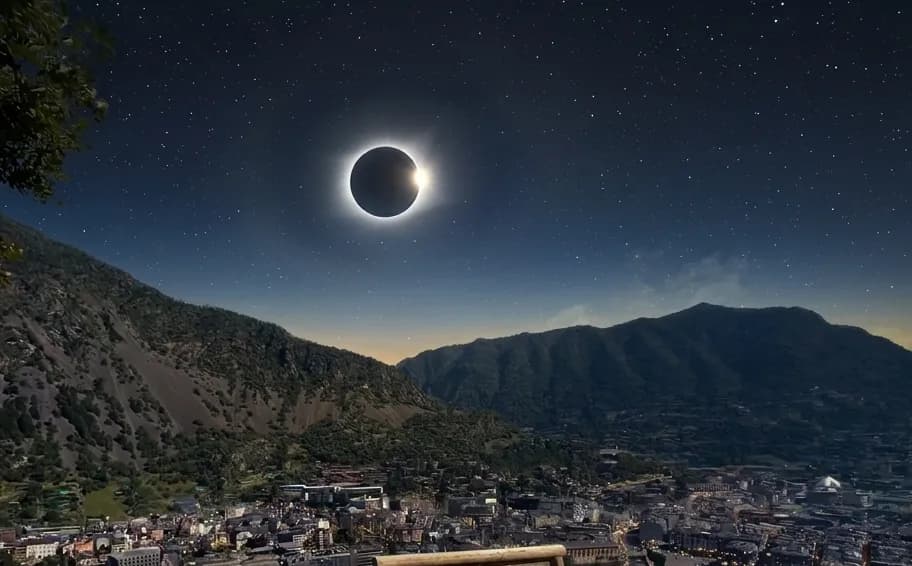
Some experts explain clearly: "It won't get completely dark. There will be a moment when the luminosity drops, and then we'll regain it."
The eclipse will not be visible from the valleys, including areas like Andorra la Vella or Escaldes-Engordany. At the moment of maximum eclipse, the Sun will be very low on the horizon and the mountains will obstruct its view from these areas. To observe it, it will be essential to move to an elevated, open area with a clear horizon.
The eclipse in Andorra will not be repeated in a century
It is also noted that, probably, more than a hundred years will have to pass for a comparable eclipse to occur from the Principality. The next total eclipse visible from similar latitudes will be in 2027, but it will be centered in North Africa. From Andorra, in 2027 it will be partial and of much lower intensity.
The confusion between Andorra and Andorra de Teruel
Some astronomy websites may be misleading. The municipality of Andorra (Teruel, Aragon), about 200 km south of the Principality, is indeed within the path of totality and will have 1 minute and 38 seconds of total eclipse at 8:30 PM CEST. When consulting information online, always check that the data refers to the Principality of Andorra and not to the Aragonese town.
What time is the eclipse in Andorra on August 12, 2026?
The solar eclipse begins in Andorra at 7:33 PM and reaches maximum obscuration at 8:27 PM (local CEST time). These times are verified by three independent astronomical sources (timeanddate.com, vercalendario.info, and tutiempo.net).
Phase | Time (CEST) | Sun altitude | Obscuration |
Start of partial eclipse | 7:33 PM | 15° | Increasing |
Maximum eclipse | 8:27 PM | 5° | 99.01% |
End of partial eclipse | Coincides with sunset | 0° | — |
The theoretical end of the partial phase would occur after 9:00 PM, but in Andorra la Vella, the sun will have already set. The eclipse will be interrupted by sunset around 8:56 PM, while the moon still covers a significant part of the disk.
Why will the sun be so low?
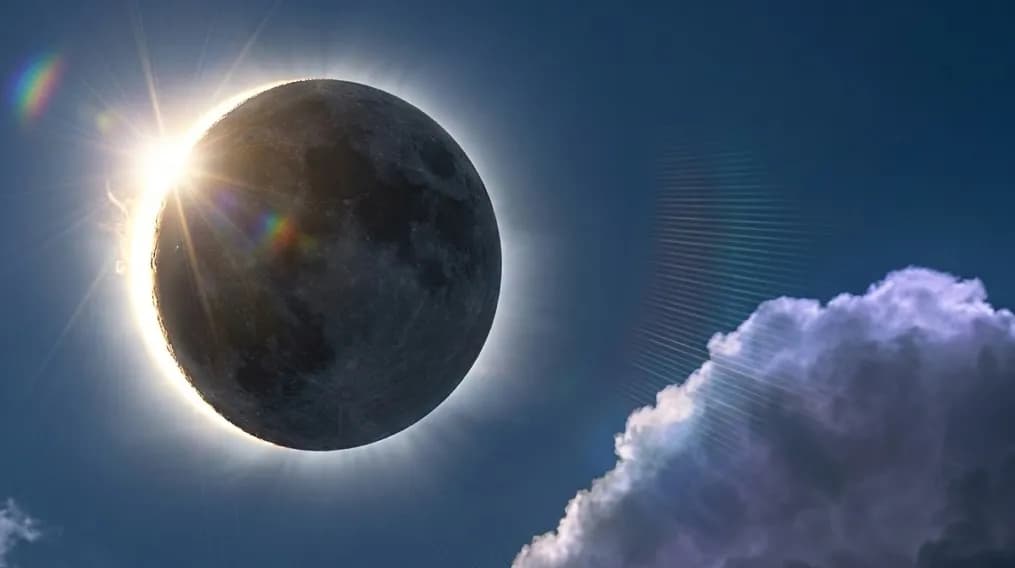
The maximum eclipse coincides with twilight. At 8:27 PM, the sun will be only 5° above the horizon, in a west-northwest direction (azimuth 286°). To get a concrete idea: at this height, a five-story building located 140 meters away already completely blocks the sun. Any relief, tree, or construction to the west of your observation point can block the eclipse at its maximum.
This makes the choice of observation location the most important factor in the entire experience.
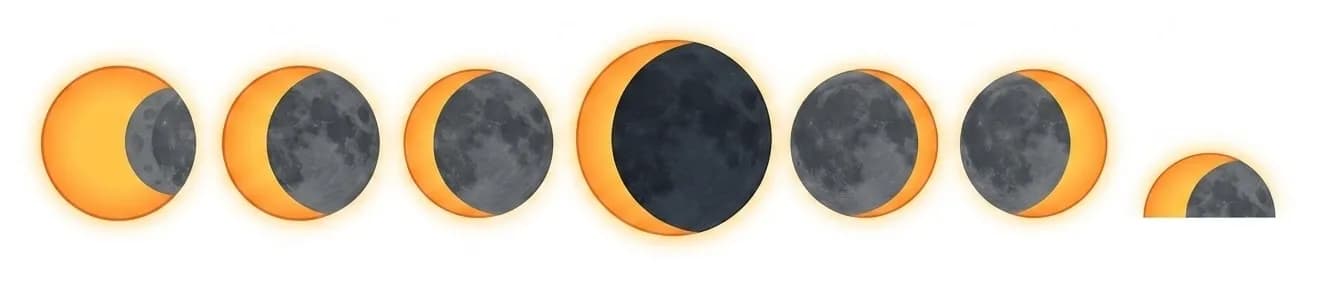
Phases minute by minute
- 19:33 h — The moon begins to cover the solar disk. The change is not noticeable to the naked eye, but approved glasses are already mandatory.
- ~20:00 h — The occultation exceeds 80%. A subtle decrease in luminosity and a slight environmental cooling begin to be noticeable.
- ~20:15 h — 90% of the sun is already covered. The sunlight acquires a different tone, less intense than a normal sunset.
- 20:27 h — Maximum: 99% of the sun covered. The sky has a unique appearance. Animals may change their behavior. The sun is 5° above the horizon.
- ~20:56 h — The sun sets while the eclipse is still in progress.
Where to watch the eclipse in Andorra? The best observation points
Given the sun's altitude of only 5° at the moment of maximum eclipse, the observation rule in Andorra is clear: the higher and with the clearest western horizon, the better. The viewpoints in the lower valley, surrounded by mountains to the west, will have the eclipse obscured at the critical moment.
There are two official events confirmed for August 12, both in high mountains and both with limited capacity. If you want to guarantee the best conditions, it is necessary to book.
You can also book other night activities in Andorra to observe the night sky of the Pyrenean country.
Eclipse Festival at Port de Cabús, La Massana (2,328 m)
The Comú of La Massana —the only parish in Andorra with Starlight certification— organizes the Eclipse Festival at Port de Cabús. The event combines guided astronomical observation, gastronomy, and a concert, and also includes the observation of the Perseids once night falls.
Date and time | August 12, 2026, from 17:00 h to 23:00 h |
Eclipse observation | From 19:30 h to 20:30 h |
Guide | Jordi Colell, Starlight monitor |
Price | €5 (includes commemorative bag and approved glasses) |
Capacity | 150 people |
Concert | 21:00–23:00 |
Perseids | Guided observation after the concert |
Access | From Coll de la Botella; road closed from 17:00 h; minibuses available |
Alternative plan (rain) | Arinsal Sociocultural Hall |
Registration | visitlamassana.ad |
The altitude of 2,328 m and the position of Port de Cabús guarantee a western horizon free of nearby relief, one of the most difficult conditions to obtain in Andorra on August 12.
Guided experience at the Tristaina Solar Viewpoint, Ordino Arcalís (2,701 m)
Ordino Arcalís has scheduled a guided experience at the Tristaina Solar Viewpoint, the 25-meter diameter spherical platform located at the summit of Peyreguils, at an altitude of 2,701 m. The place is already a reference for astronomy in the Principality: every August 7 at 7:37 h, the first sun rays pass for three minutes through a natural hole in Pico de Arcalís, a unique phenomenon in the Pyrenees that turns this space into the so-called Solar Mountain.
Date | August 12, 2026 |
Start | 6:30 PM (ascent with Creussans chairlift) |
Descent | From 8:45 PM |
Price | €17 (Grandvalira Mountain Guides + approved glasses) |
Spaces | Limited — prior reservation required |
Optional dinner | La Borda de la Coma (additional cost) |
Registration | Ordino Arcalís booking page |
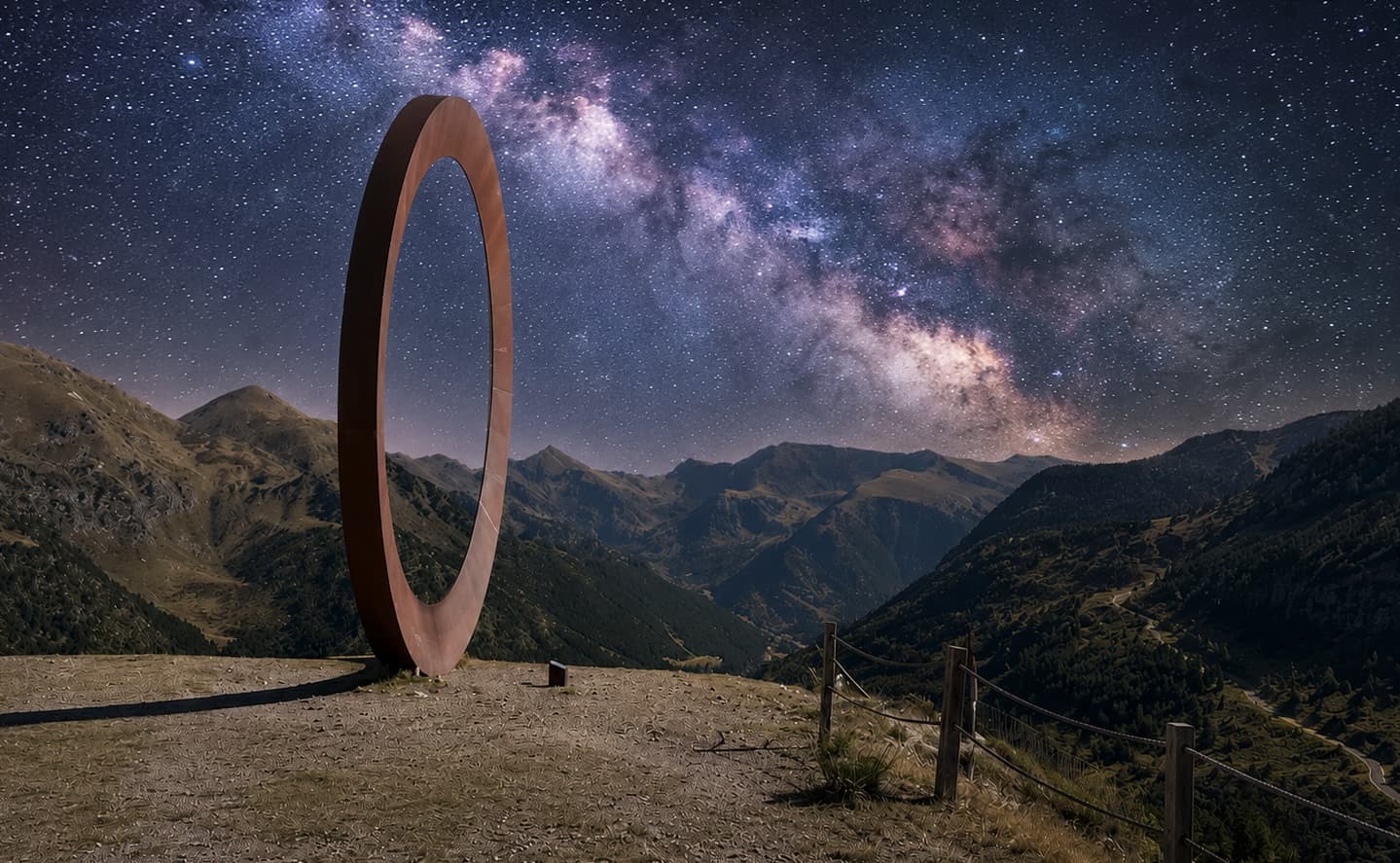
From the Mirador Solar, the 360° panorama over the Tristaina glacial cirque, the Ordino Arcalís domain, and the French valleys of Auzat offers the highest observation conditions available in the Principality.
Can you see the eclipse without attending official events?
Yes, provided you choose an elevated spot with a completely unobstructed west-northwest horizon. If you decide to observe it on your own, consult the and plan to arrive at least an hour before 7:33 PM to orient yourself correctly. Bring your own ISO 12312-2 approved glasses — essential, as there will be no moment without protection — and warm clothing if you are at high altitudes.
How to safely observe the solar eclipse?
In a partial eclipse, the sun is never completely covered. From Andorra, between 1% and 2% of the solar disk will always remain visible. Looking at the sun without protection, even for an instant, can cause irreversible retinal damage or permanent blindness. The solar intensity during 99% obscuration is still sufficient to damage the retina.
Single rule: ISO 12312-2 approved glasses are mandatory at all times, from 7:33 PM until sunset.
Conventional sunglasses — even polarized or very dark ones — do not protect. The only valid ones are those certified with the ISO 12312-2 standard, which filter 99.997% of visible light and completely block ultraviolet and infrared radiation. Both official events include them in the price.
Observation equipment
Essential:
- ISO 12312-2 approved glasses
- Mountain footwear if you are at high altitudes
- Warm clothing (at 2,300-2,700 m, the temperature drops at sunset)
- Thermal blanket if you stay to watch the Perseids.
- Headlamp for the return at night.
Recommended:
- Charged mobile with offline map and precise watch
- Solar filter for the camera (without a filter, the mobile sensor can be damaged when pointing at the sun)
- Confirmed reservation for official events, as spaces sell out
Common mistakes to avoid
Looking "for a second" without glasses. There is no safe moment during a partial eclipse. The reflex of closing your eyes is not fast enough to protect the retina from solar intensity.
Using normal sunglasses. They are useless, no matter how dark they are. Driving glasses, smoked glass glasses, and polarized ones are also not valid.
Arriving at the observation point exactly at 8:27 PM. The eclipse starts at 7:33 PM. You need to arrive with time to orient yourself towards the west-northwest and check that there are no obstacles on the horizon.
Choosing a valley viewpoint without checking the western horizon. At 8:27 PM, the sun is at 5°. A mountain or a building to the west can completely block the view at the moment of maximum eclipse.
The eclipse and the Perseids: a double astronomical night
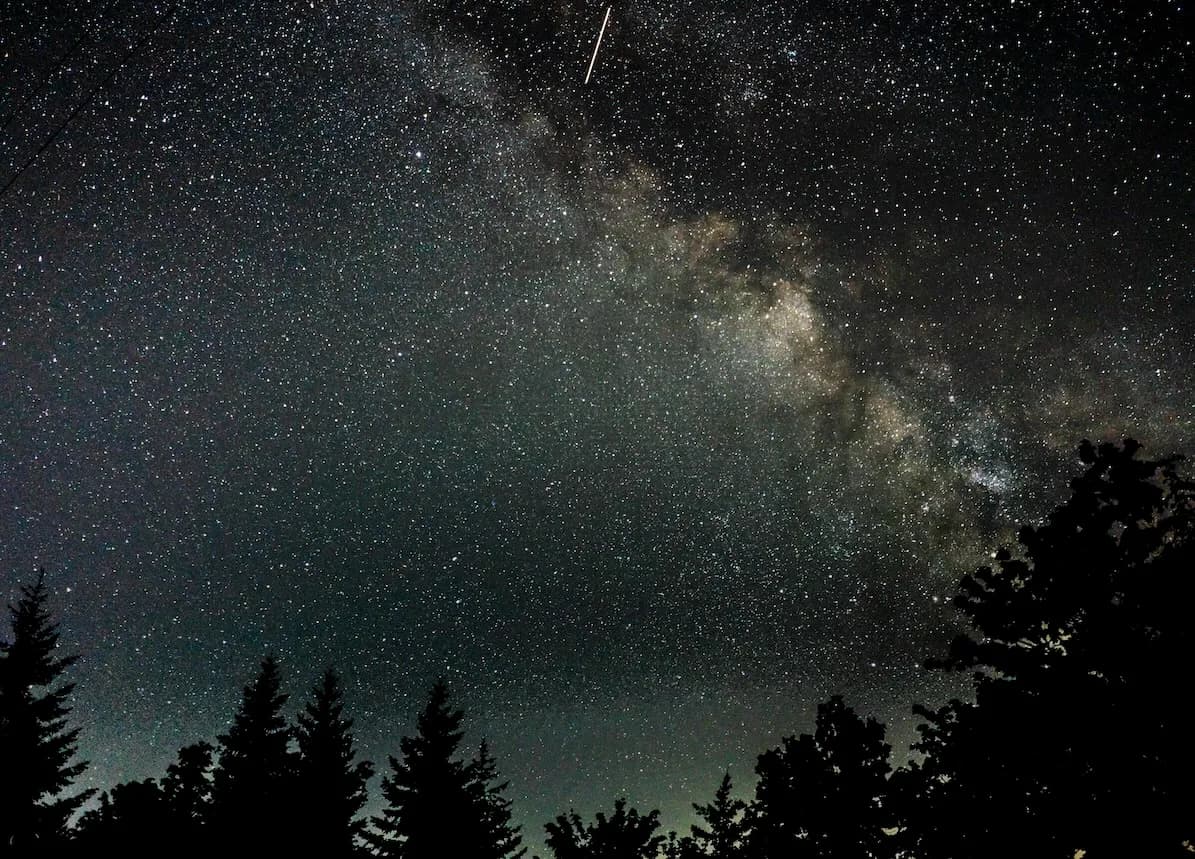
August 12 coincides exactly with the peak of the Tears of Saint Lawrence (Perseids), the most popular annual meteor shower in the Northern Hemisphere. Once the sun sets and the sky darkens, Andorra — as with certified parishes — is one of the best places in the Pyrenees to observe them.
The Port de Cabús event already includes Perseid observation in the evening program, led by Jordi Colell. The Perseids occur when Earth passes through the dust trail of comet Swift-Tuttle and, under ideal sky conditions, can generate up to 100 meteors per hour. From high mountains in Andorra, without light pollution, the conditions are exceptional.
If you decide to stay and watch them after the eclipse, bring a headlamp, thermal blanket, and warm clothing. The combination of these two astronomical events makes August 12 a night that will hardly be repeated.
Want to see the total eclipse? The path of totality is less than 3 hours away
If you prefer to experience totality — the 60 to 110 seconds of absolute darkness where the solar corona is visible — the path crosses Lleida, Aragon, Asturias, Cantabria, Castile and León, the Valencian Community, and the Balearic Islands. From Andorra, Lleida is less than an hour and a half away by car.
It should be noted, however, that throughout the Spanish path, the sun will be between 2° and 12° above the horizon at the moment of totality: the same requirements for an observation point with a clear western horizon as in Andorra. Furthermore, a very high concentration of visitors is expected throughout the area.
For many tourists who will already be in the Principality on August 12, observing 99% from a high mountain viewpoint in Andorra is a real, comfortable, and much less crowded alternative than traveling.
Book accommodation in Andorra for August 12
The eclipse weekend is one of the highest demand weekends of the summer. If you want to stay in the Principality to experience the phenomenon and avoid traveling that evening, book in advance. Staying in Andorra allows you to reach the observation points calmly and stay to watch the Perseids without rushing.
Frequently asked questions
You may be interested in
Most read